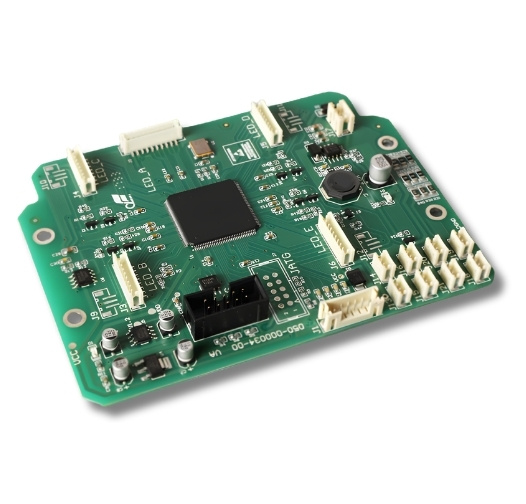
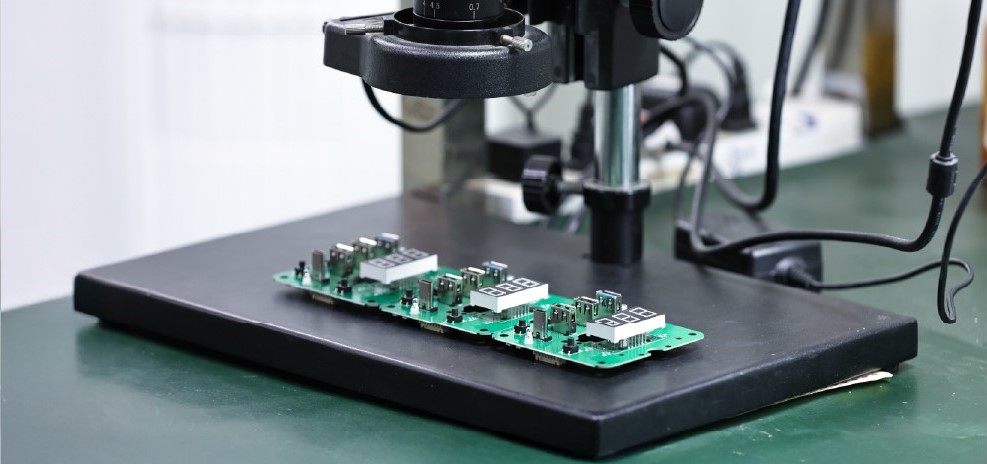
Surface Mount Technology (SMT) assembly is an automated assembly method in which electronic components are mounted directly onto a Printed Circuit Board (PCB). Compared to the conventional through-hole technique, which involves the use of lead wires that pierce the holes in the board, SMT uses printed solder paste on flat copper pads. High-speed robotic pick-and-place machines position the components, which are then permanently bonded in a controlled reflow oven.
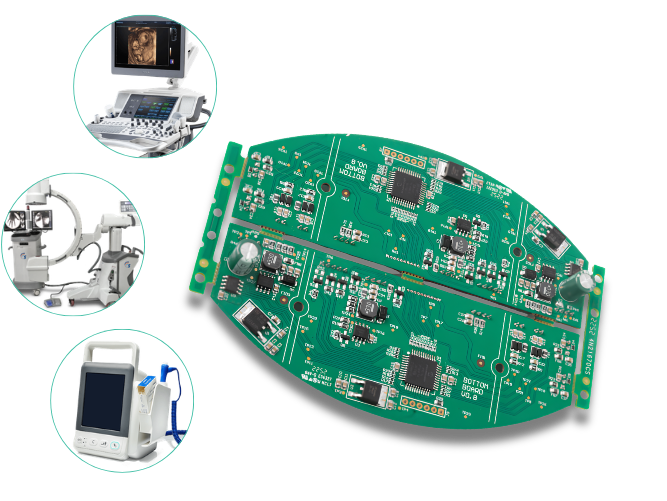
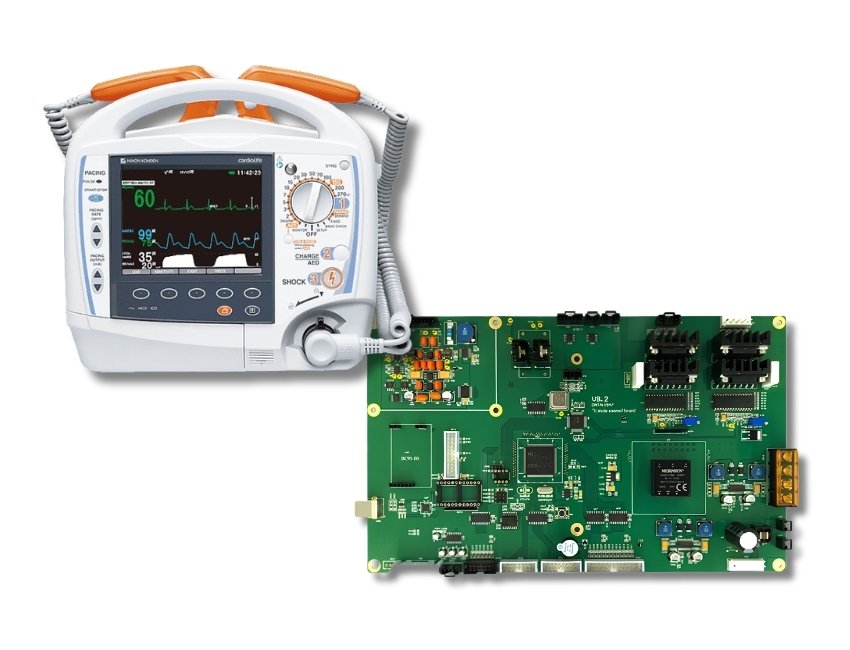
SMT is the foundation of hardware development in the medical device industry. It allows engineers to pack complex processing power, advanced wireless connectivity, and vital sensory modules into incredibly small form factors—such as wearable cardiac monitors and implantable medical devices.
| Order Quantity | ≥1 PCS (Prototype to Mass Production) |
| Assembly Technologies | SMT (Surface Mount), THT (Through-Hole), Mixed-Technology |
| Board Substrates | Rigid (FR-4, High-Tg), Flex, Rigid-Flex, Metal Core (Alum) |
| Component Placement Accuracy | ±0.035 mm (±0.025 mm) Cpk≥1.0 |
| Minimum Component Size | 01005 (0.4 mm × 0.2 mm) |
| BGA / QFN Capability | Down to 0.2 mm pitch with 3D X-Ray Inspection |
| Solder Paste Chemistry | Lead-free (RoHS compliant), Water-soluble, No-clean options |
| Inspection Standards | Inline 3D SPI, Inline 3D AOI, 3D X-ray (AXI), First Article Inspection (FAI) |
| Conformal Coating | Acrylic (AR), Silicone (SR), Polyurethane (UR), UV Cure |
| Quality Compliance | ISO 13485, ISO 9001:2015, IPC-A-610 Class 3, RoHS, REACH |


The continuous miniaturization of SMT components creates higher requirements for handling, placement accuracy, and manufacturing control.
• Miniaturization: Miniature packages such as 01005 components require advanced pick-and-place equipment and precise vision alignment systems to maintain placement accuracy.
• Placement Accuracy: The alignment should be done with high precision to prevent misalignment. Misaligned parts can lead to functional failures and reliability problems.
• Static Sensitivity: Careful handling is required for some SMT components because they are sensitive to static electricity. To protect components from damage, the use of ESD (Electrostatic Discharge) protection measures is necessary.
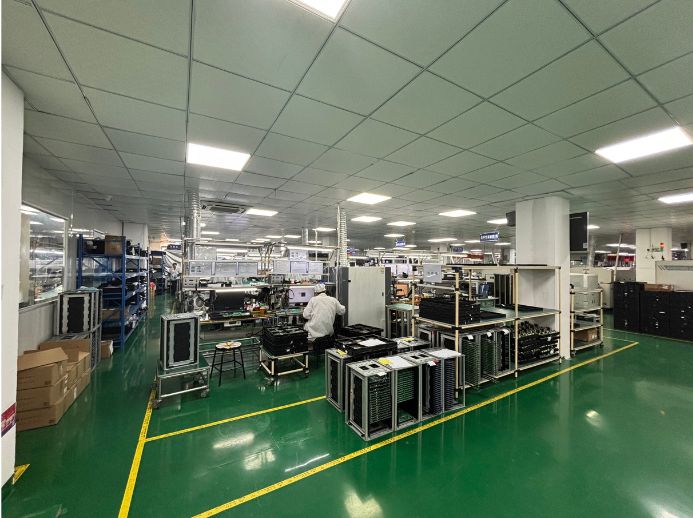
Our Solution: Our factory is equipped with advanced SMT lines integrated with high-resolution vision systems and precision pick-and-place equipment.
This precision hardware supports reliable mounting of miniature components and maintains strict placement accuracy for your high-density medical PCB assembly project.

Medical electronics are frequently subjected to physical stress, making the durability of the connections a critical safety factor.
• Mechanical Stress: Devices are often exposed to shocks, vibrations, or continuous bodily movement. Robust joints are required to prevent micro-cracks from developing under structural stress.
• Thermal Profiling: Precise temperature control ensures proper wetting and bonding without damaging sensitive medical components.
Our Solution: Our facility utilizes advanced multi-zone reflow ovens that maintain precise thermal profiles to help ensure stable solder bond formation. Furthermore, integrated 3D automated optical inspection (AOI) and X-ray systems assist in verifying solder joint integrity, supporting the structural durability needed for medical electronics.

High-density medical processors often utilize Ball Grid Arrays (BGAs), which conceal their connections beneath the component package.
• Hidden Solder Joints: Manual visual inspection of BGA connections is impossible. Hidden defects like solder voids or bridging cannot be detected with standard optical tools.
• Advanced Verification: Resolving this requires high-resolution 3D X-ray inspection. This technology allows engineers to inspect hidden solder joints beneath the package to analyze the internal joint structures.
Our Solution: Our facility utilizes high-resolution 3D X-ray inspection systems to analyze the internal structure of BGA connections. This technology helps identify hidden defects, such as solder voids or bridging beneath the component package, supporting the quality assurance standards required for high-density medical electronics.

Medical SMT assembly often involves temperature-sensitive components that require precise soldering control.
• Component Protection: Improper reflow temperatures can damage sensitive ICs, sensors, and miniature components. Accurate thermal profiling helps prevent overheating and maintains component reliability.
• Process Consistency: Automated thermal profiling and monitoring ensure every PCB assembly follows the validated soldering parameters required for medical-grade manufacturing.
Our Solution: Our facility utilizes advanced multi-zone reflow ovens equipped with precise thermal profiling software. This allows for the development and real-time monitoring of custom thermal profiles tailored to the specific requirements of temperature-sensitive medical components, supporting consistent solder bond formation while helping to protect the integrity of the PCB assembly.

Many medical designs use a hybrid approach, combining SMT’s high-density efficiency with THT’s mechanical durability.
|
Feature |
Surface Mount Technology (SMT) |
Through-Hole Technology (THT) |
|
Component Size |
Extremely small (down to 01005) |
Larger, leaded parts |
|
Component Density |
High (components can be placed on both sides) |
Low to moderate (single-sided placement) |
|
Mechanical Bond Strength |
Moderate (relies on surface tension and solder) |
High (physical lead runs through the board) |
|
Assembly Speed |
Fast, fully automated high-speed runs |
Slower, often requires manual insertion |
|
Typical Medical Use |
Wearables, pacemakers, high-frequency circuits |
Power supplies, connectors, heavy-duty switches |
Accelerate your medical device launch with our ISO 13485-certified SMT assembly services. Contact us today to discuss your project specifications and receive a tailored quote.
Our Medical SMT Assembly FAQ addresses essential questions regarding your surface-mount manufacturing requirements. We cover our SMT capabilities for complex medical electronics, precise component placement, rapid assembly timelines, rigorous quality inspection protocols (including Automated Optical Inspection), and our capacity to scale from initial prototype runs to volume production batches. For every medical device project, we guarantee precision-focused, medical-grade SMT assembly standards.
To initiate an SMT assembly quote, we need your PCB Gerber files in RS-274X format, a Bill of Materials (BOM) in Excel format having the manufacturer part number, and the Centroid (Pick-and-Place / XY) file having rotation and coordinate data.
Our sophisticated automated high-speed pick-and-place machines are certified to reliably place 01005 passive components (0.4 mm × 0.2 mm) as well as fine-pitch ICs.
Yes. We carry out inline 3D Automated X-ray Inspection (AXI) to inspect for voids, bridging, misalignment, and solder defects underneath BGAs, QFNs, and other leadless components.
We strictly follow J-STD-033 standards. All MSL-rated components are stored in temperature and humidity-controlled dry cabinets, baked before assembly when required, and tracked to monitor exposure times during the manufacturing run.
Definitely. We are specialists in fine-pitch BGAs with pitches down to 0.2 mm. With our vision alignment system and thermal profiling software, we guarantee that fine pitch ball-to-pad registration is perfect.
The time it requires to assemble leads of SMT is primarily driven by sourcing of components availability for long-lead-time or specialized medical microcontrollers. Once you have everything (i.e. all components, stencils, and PCBs) in-house, the actual SMT assembly can take as little as 24 to 48 hours.
You should use a combination of SMT and THT if your design needs high-density computing, which is best served by SMT. Use THT for heavy, high-stress components that require mechanical strength. These include connection blocks, power transformers, large capacitors, or interface connectors.
We use complete manufacturing execution software (MES) to trace component reel barcodes to their placement run. We retain complete build files, test logs, and batch certificates of the material for 100% downstream traceability.
English
French
German
Japanese
Korean