1. What Types of PCBs Used for LED PCB Assembly?
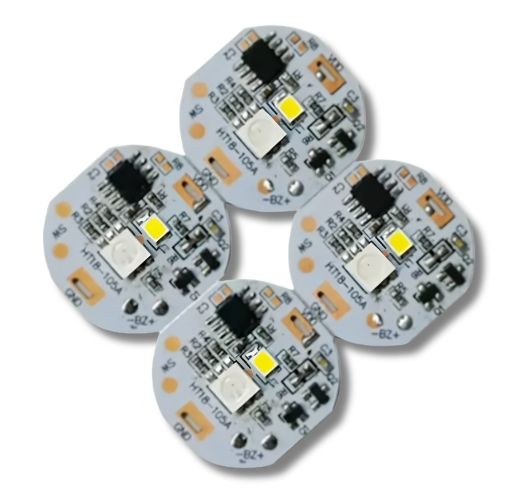
Medical LED PCBs utilize several substrate types, each selected for specific thermal and mechanical requirements:
| Substrate Type |
Material |
Best For |
| MCPCB (Aluminum) |
Aluminum base with dielectric layer |
High-power surgical lights, dental curing |
| MCPCB (Copper-Core) |
Copper base with dielectric layer |
Extreme thermal loads, UV LED arrays |
| Ceramic PCB |
Al₂O₃ (Alumina) or AlN (Aluminum Nitride) |
Highest thermal conductivity, wire-bonded LEDs |
| Flex LED PCB |
Polyimide (PI) / Kapton |
Wearable phototherapy, catheter-mounted LEDs |
| Rigid-Flex LED |
FR4 + Polyimide hybrid |
Complex 3D medical instruments with LED arrays |
| FR4 with Thermal Vias |
Standard FR4 + dense via arrays |
Low-to-moderate power LED indicators, sensors |
2. What Certifications Are Required for Medical LED PCB Assembly?
Medical LED PCB assembly should be performed under ISO 13485 (Medical Device Quality Management), with manufacturing to IPC-A-610 Class 3 acceptance criteria. Depending on the device classification (Class I, II, or III per FDA), compliance with ISO 14971 (Risk Management) and IEC 60601 (Medical Electrical Equipment) may also apply at the device level. PCBTok holds ISO 13485 and ISO 9001:2015 certifications with full Class 3 manufacturing capability.
3. Can You Assemble High-Power LEDs for Surgical Lighting?
Yes. We routinely assemble high-power LEDs (1 W to 50 W+ per device) on aluminum and copper-core MCPCBs for surgical and examination lighting. Our thermal management expertise including substrate selection, thermal via optimization, and controlled reflow profiling ensures reliable solder joints and consistent optical output under continuous operation.
4. How Do You Ensure Optical Alignment Accuracy for LEDs?
We employ vision-aligned pick-and-place systems that optically center each LED component before placement, achieving repeatable accuracy within ±25 µm. Post-placement AOI verifies position relative to fiducials and optical axis references. For applications requiring the highest precision, we offer active optical alignment where LED position is adjusted while monitoring real-time light output.
5. How Do You Manage Thermal Dissipation on High-Power LED Boards?
Our approach is substrate-driven and application-specific: aluminum MCPCBs for cost-effective moderate-power designs, copper-core boards for higher thermal loads, and aluminum nitride ceramic for extreme power densities. We optimize thermal via count, diameter, and copper weight during DFM, and validate thermal performance through junction temperature measurement and infrared thermography during functional testing.
6. How Do You Clean Medical LED PCBs to Prevent Ionic Contamination?
We use closed-loop aqueous cleaning systems with medical-grade saponifiers optimized for flux removal from MCPCB and ceramic substrates. Since LED lenses and wire bonds are sensitive to mechanical and chemical damage, we validate cleaning parameters for each assembly configuration. Post-clean ROSE (Resistivity of Solvent Extract) testing confirms ionic residue levels meet medical device thresholds.
7. Can You Safely Reflow Heat-Sensitive LED Components?
Yes. Many high-brightness LEDs and plastic-packaged optical sensors have limited tolerance for peak reflow temperatures and time-above-liquidus duration. We develop customized reflow profiles that achieve thorough solder wetting while respecting the LED manufacturer's maximum thermal exposure specifications. When necessary, we utilize vapor phase soldering for its precise, uniform temperature control with no risk of overheating.
8. Do You Handle Lead-Free (RoHS) LED Soldering for Healthcare Devices?
Yes, our facility operates dedicated lead-free (RoHS compliant) SMT assembly lines to prevent cross-contamination. Lead-free soldering is standard for all modern wearable, portable, and single-use medical devices. For exempt Class III implantable or life-sustaining devices, we also support tin-lead assembly under controlled protocols.
9. How Is Traceability Maintained During LED PCB Assembly?
Our Manufacturing Execution System (MES) tracks every panel through the facility by unique serial number. At each stage, operators scan material reels, LED bin codes, solder paste lots, and reflow profile records, linking them directly to the individual board. This creates a complete digital thread supporting ISO 13485 traceability requirements from incoming materials to final optical test results.
10. Do You Offer Conformal Coating or Encapsulation for Medical LED Boards?
Yes. We apply medical-grade conformal coatings (acrylic, silicone, parylene) and potting compounds to protect LED assemblies from moisture, bodily fluids, and chemical sterilization agents. We carefully mask LED optical surfaces and flexible zones to ensure coatings protect electronics without blocking light output or compromising substrate flexibility.
11. Can Your Facility Support Low-Volume, High-Mix Medical LED Assembly?
Yes, we specialize in the low-volume, high-mix production model essential for clinical trials, specialized surgical instruments, and niche diagnostic devices. Our agile changeover protocols and dedicated prototype SMT line allow efficient production of complex medical LED assemblies without demanding high minimum order quantities.
12. What Types of Medical LED Applications Do You Support?
We support the full spectrum of medical LED applications including surgical and examination lighting, endoscope and laparoscope illumination, phototherapy (UV, blue, red light therapy), pulse oximetry and PPG sensors, dental curing and whitening, UV-C disinfection, fluorescence excitation for diagnostic imaging, wearable light-based monitors, and implantable optogenetic stimulation devices.