1. Why Are Rogers Materials Preferred Over FR4 for Medical RF Applications?
| Parameter / Metric |
Standard FR4 |
Rogers High-Frequency Materials |
| High-Frequency Performance |
Moderate; suitable mainly for digital and lower-frequency analog circuits. |
Excellent; engineered specifically for high-frequency RF and microwave applications. |
| Dielectric Constant (Dk) Stability |
Varies significantly across temperature and wide frequency ranges, risking signal distortion. |
Exceptionally stable across varying temperatures and frequencies, ensuring reliable phase control. |
| Electrical Signal Loss (Df / "Loss Tangent") |
Higher dissipation factor (≈0.015-0.020), leading to severe signal attenuation at higher frequencies. |
Ultra-low loss tangent (≈0.002-0.004), preserving weak medical telemetry and imaging signals. |
| Impedance Control Precision |
Moderate tolerance control; vulnerable to thickness variations in high-frequency layouts. |
High precision; maintains tight impedance control (within ±5%) for sensitive RF circuits. |
| Moisture Absorption |
Higher (typically >0.25%), which can alter electrical properties over time in humid clinical settings. |
Extremely low moisture absorption, protecting long-term device reliability and performance. |
| Medical Application Suitability |
Standard power supplies and basic control interfaces. |
MRI receiver coils, ultrasound beamformers, surgical RF ablation, and wireless implantable telemetry. |
2. What Rogers Series Is Best for High-Frequency Medical Imaging?
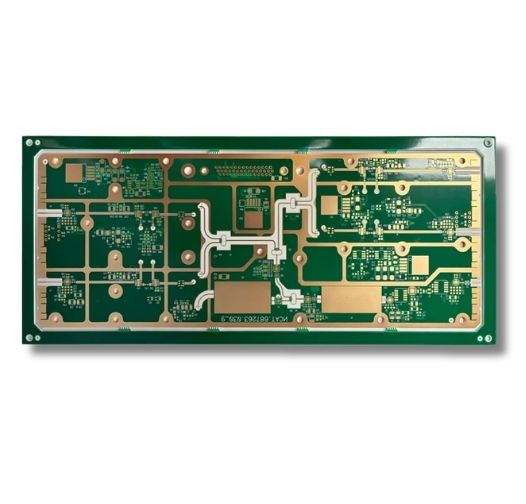
The RO4000 series is ideal for most medical RF and imaging applications due to its excellent electrical performance and cost-effective manufacturing compatibility. For extremely sensitive microwave frequencies, our RT/duroid series is often the preferred choice.
3. Does MedPCB Support Rogers-to-FR4 Hybrid Laminations?
Yes. We fabricate hybrid circuit boards that combine high-frequency Rogers materials on outer layers with cost-effective FR4 on inner layers, helping you optimize both performance and project budget.
4. How Do You Ensure Consistent DK/DF Across Medical PCB Batches?
We source materials exclusively from trusted suppliers, inspect incoming lots rigorously, and maintain strict process controls in our lamination and etching departments to ensure uniform dielectric constants across every production run.
5. Can You Manufacture Multilayer Rogers PCBs for Medical Devices?
Yes. While many high-frequency boards are single or double-sided, we frequently fabricate complex multilayer Rogers and hybrid boards containing up to 40 layers for advanced medical electronics.
6. What Surface Finishes Work Best with Rogers High-Frequency Laminates?
Electroless Nickel Immersion Gold (ENIG) and Electroless Nickel Electroless Palladium Immersion Gold (ENEPIG) are our top recommendations. They provide flat, highly solderable surfaces that protect high-frequency traces without introducing signal loss.
7. How Do You Handle PTFE-Based Rogers Material Drilling?
We use specialized diamond-coated drill bits, optimized spindle speeds, and custom feed rates designed specifically for soft substrates, preventing burrs and protecting the integrity of the board edges.
8. What Minimum Trace Width and Spacing Can You Achieve on Rogers?
Depending on copper thickness and material selection, we routinely achieve fine-line trace widths and spacing down to 0.075 mm, supporting dense high-frequency medical layouts.
9. Do You Offer Controlled Impedance Testing and TDR Reports?
Yes. Every controlled impedance batch undergoes thorough Time Domain Reflectometry testing, and we provide detailed TDR reports with your shipment to verify compliance with your design specifications.
10. Can MedPCB Source Specific Rogers Laminates for Low-Volume Medical Prototypes?
Yes. We maintain an agile manufacturing setup equipped to handle low-volume prototype runs, allowing you to test and validate your high-frequency medical designs quickly before moving to mass production.
11. What IPC Class Is Your Medical Rogers PCB Manufacturing Certified For?
We manufacture medical boards to strict IPC-6012 Class 2 standards, with full capabilities available for Class 3 compliance depending on your product requirements.
12. How Do You Maintain Traceability in Medical-Grade Rogers PCB Production?
We maintain end-to-end documentation tracking material lot numbers, processing parameters, and inspection results throughout every stage of fabrication to ensure complete transparency and compliance.
13. Can You Provide Laser-Direct Imaging (LDI) for Fine-Pitch Rogers Designs?
Yes. Our facility features advanced Laser-Direct Imaging systems that bypass traditional photomasks, enabling exceptional alignment accuracy for ultra-fine-pitch high-frequency circuits.