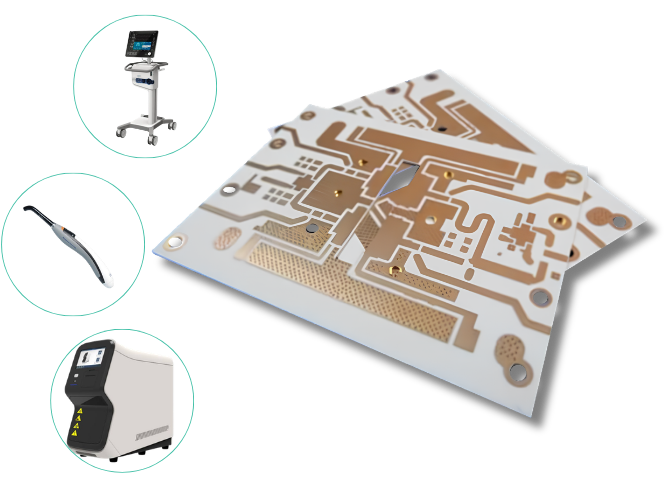
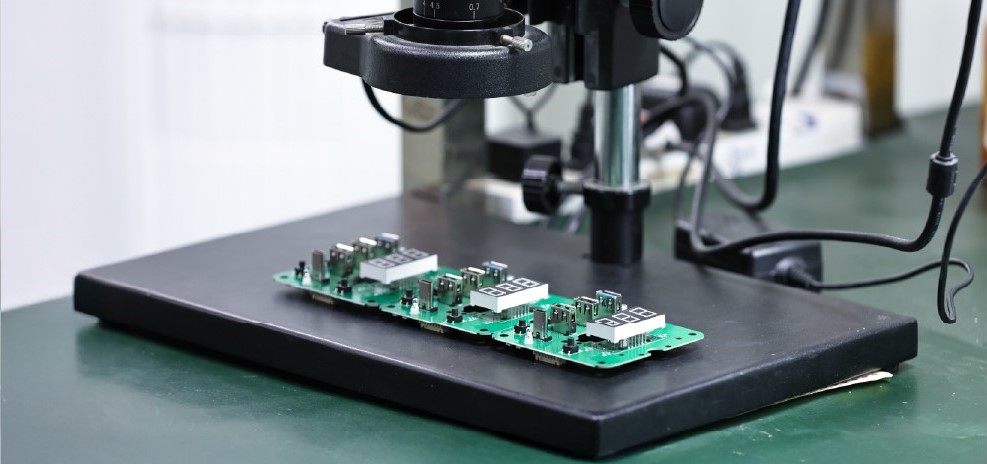
A medical ceramic PCB uses ceramic substrates such as alumina and aluminum nitride to provide electrical insulation and efficient heat dissipation. Compared with conventional FR-4, ceramic substrates offer higher thermal conductivity and stable performance under demanding temperature conditions. Depending on the substrate and circuit requirements, ceramic PCBs can use different metallization technologies to form conductive circuits and interconnections. They are suitable for medical electronics that require reliable thermal management, electrical insulation, and long-term stability.
|
Technical
Parameter |
Specification
/ Capability |
|
Product
Category |
Aluminum Oxide, Aluminum
Nitride Ceramics |
|
Substrate
Thickness |
0.25 mm, 0.3 mm,
0.38 mm, 0.5 mm, 0.635 mm, 1.0 mm, 1.5 mm, 2.0 mm |
|
Thermal
Conductivity |
Alumina:
20–24 W/m·K Aluminum Nitride:
170–220 W/m·K |
|
Conductor
Type & Thickness |
Copper (10 µm – 300
µm) |
|
Surface
Finish Options |
Immersion Silver
(Ag), Immersion Gold (ENIG), ENEPIG (Ni/Pd/Au), OSP |
|
Material
Reflectivity |
Standard: 85%–92% |
High Reflectivity: 93% |
|
Board
Production Size |
114 × 114 mm, 120 ×
120 mm, 130 × 140 mm, 140 × 190 mm |
|
Min.
Via Hole Diameter |
0.2 mm |
|
Min.
Trace Width / Space |
0.1 mm / 0.1 mm (4
mil / 4 mil) |
|
Dimensional
Tolerance |
±0.1 mm |
|
Warpage
/ Distortion |
≤0.3% |
|
Peel
Strength (Peel/Strip) |
≥ 15 N |
|
Dielectric
Constant ( |
9–10 (Tested at 1
MHz) |
|
Dielectric
Withstand Voltage |
≥2000 V |
|
Thermal
Shock Resistance |
-40°C to +150°C
(100 cycles) |
|
Standard
Turnaround Time |
Prototypes/Samples:
12 Days Mass Production:
15–20 Days |


Challenge: Ceramic substrates are brittle and can develop cracks during drilling, cutting, or assembly. Small defects may affect board reliability.
Our Solution: We use controlled machining and precision processing methods to reduce mechanical stress during production. Based on your board structure and substrate, our engineers can also recommend suitable processing methods to reduce the risk of cracking or chipping.

Challenge: Reliable copper adhesion is essential for ceramic PCBs. Poor bonding can cause peeling, cracking, or electrical connection issues during thermal cycling.
Our Solution: We maintain controlled metallization processes to support strong copper-to-ceramic bonding. Our engineering team can also suggest alternative metallization options when your design requires different performance characteristics.

Challenge: Differences in CTE between the ceramic substrate, components, and solder joints can create stress during repeated heating and cooling.
Our Solution: We manufacture according to your specified material and CTE requirements. If thermal expansion is a concern, our engineers can recommend suitable ceramic materials or construction options to improve thermal-cycle reliability.

Challenge: High-power medical electronics can generate concentrated heat. The ceramic material and thermal design directly affect heat dissipation and device reliability.
Our Solution: We manufacture with the ceramic material specified for your project and can suggest suitable material alternatives based on thermal conductivity, operating temperature, and other design requirements.

At MedPCB, we support several ceramic substrate options for different medical applications and operating conditions.
Alumina offers good mechanical strength, excellent electrical insulation, and thermal conductivity of around 20–24 W/m·K. It is a practical choice for surgical equipment, telemetry systems, and medical sensor circuits.
Aluminum Nitride provides high thermal conductivity of around 170–220 W/m·K, making it suitable for medical electronics that generate significant heat. Common applications include high-intensity surgical lighting, power converters, and laser therapy equipment.
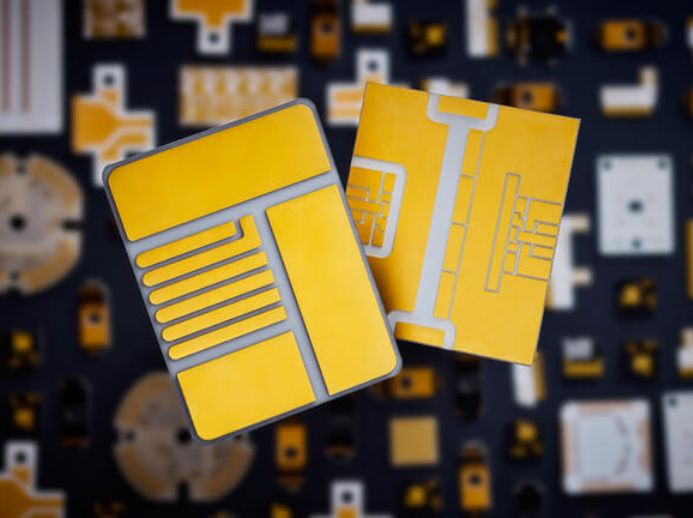
Silicon Nitride provides high mechanical strength, fracture toughness, and thermal stability. It is suitable for medical electronics exposed to mechanical shock, vibration, and repeated thermal cycling, including rugged diagnostic equipment and demanding power modules.
MedPCB supports your medical ceramic PCB projects with free DFM review. ContactMedPCB for an instant quote.
Our Medical Ceramic PCB FAQ addresses essential questions regarding your manufacturing requirements. We cover our capabilities for complex medical electronics, supply chain management, assembly timelines, rigorous quality inspection protocols, and our capacity to scale from initial builds to production batches. For every medical device project, we guarantee precision-focused, medical-grade assembly standards.
Low dielectric constant ceramics minimize signal delay, attenuation, and crosstalk in gigahertz-range medical electronics. Unlike organic FR-4 laminates, ceramic substrates resist moisture absorption and maintain stable electrical performance across wide temperature ranges.
Yes. Raw ceramic materials (such as AlN) and high-temperature metallization processes carry higher upfront costs than standard FR-4. However, their superior thermal management and long-term reliability make them necessary for life-critical medical devices.
English
French
German
Japanese
Korean