Medical Ceramic PCB

We manufacture high-reliability ceramic PCBs designed for extreme thermal performance and miniaturization in medical electronics. Our advanced substrate processing and certified quality standards ensure maximum durability and precision for life-critical devices.

• ISO 13485, ISO 9001 & IPC-A-610 Class 2/3 Compliant
• Alumina Thermal Conductivity >20 W/m·K
• Aluminum Nitride Thermal Conductivity >170 W/m·K
• Supports DPC, LTCC, HTCC, DBC, and AMB Technologies
• High-Thermal Substrates Including Alumina, Aluminum Nitride & Silicon Carbide
Medical Ceramic PCB
Certifications
What is Medical Ceramic PCB
introduction

What is Medical Ceramic PCB?

A medical ceramic PCB uses ceramic substrates such as alumina and aluminum nitride to provide electrical insulation and efficient heat dissipation. Compared with conventional FR-4, ceramic substrates offer higher thermal conductivity and stable performance under demanding temperature conditions. Depending on the substrate and circuit requirements, ceramic PCBs can use different metallization technologies to form conductive circuits and interconnections. They are suitable for medical electronics that require reliable thermal management, electrical insulation, and long-term stability.

Products
 

Advantages of Medical Ceramic PCB

  • High Thermal Conductivity
  • Strong Electric Insulator
  • Low Moisture Absorption & Chemical Resistance
  • Exceptional Mechanical Durability 
  • Stable Dielectric Properties
High Thermal Conductivity
Ceramic substrates provide efficient heat transfer and high thermal stability. Their low coefficient of thermal expansion (CTE) can help reduce thermal stress on components and interconnections during temperature cycling.
Strong Electric Insulator
Low Moisture Absorption & Chemical Resistance
Exceptional Mechanical Durability 
Stable Dielectric Properties
Why Choose Us

Choosing MedPCB as Medical Ceramic PCB Partner

  • ISO 13485 Certified Manufacturing

    ISO 13485 Certified & Medical-Grade Quality

    Our production facilities operate under strict ISO 13485, ISO 9001, and applicable IPC Class 2 or Class 3 requirements. We maintain full regulatory compliance to ensure every ceramic PCB delivers the ultra-high reliability required for life-critical healthcare applications.

  • In-Stock High-Thermal Ceramic Substrates

    In-Stock High-Thermal Ceramic Substrates

    We maintain inventory of premium ceramic materials, including Alumina (20–24 W/m·K) and Aluminum Nitride (170–220 W/m·K). This helps us respond to different thermal, electrical, and dimensional requirements and plan material procurement according to project needs

  • Supports DPC, LTCC, HTCC, DBC, and AMB Technologies

    Supports DPC, LTCC, HTCC, DBC, and AMB Technologies

    Depending on substrate material and your project requirements, we support selected ceramic metallization and fabrication processes, including DPC, DBC, AMB, thick-film, and thin-film technologies.

  • Free DFM Engineering Support

    Free DFM Engineering Support

    Our expert engineering team performs a full Design for Manufacturability (DFM) review on every ceramic design before fabrication. We identify potential layout errors, thermal mismatches, and trace routing conflicts early, preventing costly redesigns and accelerating your time-to-market.

  • Cost-Effective Ceramic Manufacturing

    Cost-Effective Ceramic Manufacturing

    Leveraging advanced Laser Activation Metallization (LAM) and optimized sintering processes, we make complex ceramic PCB fabrication highly affordable. We deliver premium thermal management and high-density routing without inflating your project budget.

Specs

Technical Specification

Technical Parameter

Specification / Capability

Product Category

Aluminum Oxide, Aluminum Nitride Ceramics

Substrate Thickness

0.25 mm, 0.3 mm, 0.38 mm, 0.5 mm, 0.635 mm, 1.0 mm, 1.5 mm, 2.0 mm

Thermal Conductivity

Alumina: 20–24 W/m·K

Aluminum Nitride: 170–220 W/m·K

Conductor Type & Thickness

Copper (10 µm – 300 µm)

Surface Finish Options

Immersion Silver (Ag), Immersion Gold (ENIG), ENEPIG (Ni/Pd/Au), OSP

Material Reflectivity

Standard: 85%–92% | High Reflectivity: 93%

Board Production Size

114 × 114 mm, 120 × 120 mm, 130 × 140 mm, 140 × 190 mm

Min. Via Hole Diameter

0.2 mm

Min. Trace Width / Space

0.1 mm / 0.1 mm (4 mil / 4 mil)

Dimensional Tolerance

±0.1 mm

Warpage / Distortion

 ≤0.3%

Peel Strength (Peel/Strip)

 ≥ 15 N

Dielectric Constant ()

9–10 (Tested at 1 MHz)

Dielectric Withstand Voltage

≥2000 V

Thermal Shock Resistance

-40°C to +150°C (100 cycles)

Standard Turnaround Time

Prototypes/Samples: 12 Days

Mass Production: 15–20 Days

Technical Specification Ceramic PCB
Capabilities

MedPCB Medical Ceramic PCB Process

Step 1: Substrate Preparation
The manufacturing process begins with deep surface cleaning and polishing of the ceramic substrate. Achieving nanoscale flatness at this initial stage is critical to prevent surface defects, eliminate air pockets, and ensure maximum thermal transfer across the board.
Step 2: Metallization & Circuit Formation 
Step 3: Drilling and Interconnection
Step 4: Controlled Firing & Sintering 
Step 5: Surface Finishing & Plating
Quality Control

Common Challenges in Medical Ceramic PCB Manufacturing

  • Ceramic Brittleness & Precision Processing

    Ceramic Brittleness & Precision Processing

    Challenge: Ceramic substrates are brittle and can develop cracks during drilling, cutting, or assembly. Small defects may affect board reliability.

    Our Solution: We use controlled machining and precision processing methods to reduce mechanical stress during production. Based on your board structure and substrate, our engineers can also recommend suitable processing methods to reduce the risk of cracking or chipping.

  • Metallization & Adhesion Reliability

    Metallization & Adhesion Reliability

    Challenge: Reliable copper adhesion is essential for ceramic PCBs. Poor bonding can cause peeling, cracking, or electrical connection issues during thermal cycling.

    Our Solution: We maintain controlled metallization processes to support strong copper-to-ceramic bonding. Our engineering team can also suggest alternative metallization options when your design requires different performance characteristics.

  • CTE Matching & Thermal Cycling

    CTE Matching & Thermal Cycling

    Challenge: Differences in CTE between the ceramic substrate, components, and solder joints can create stress during repeated heating and cooling.

    Our Solution: We manufacture according to your specified material and CTE requirements. If thermal expansion is a concern, our engineers can recommend suitable ceramic materials or construction options to improve thermal-cycle reliability.

  • Thermal Management & Material Selection

    Thermal Management & Material Selection

    Challenge: High-power medical electronics can generate concentrated heat. The ceramic material and thermal design directly affect heat dissipation and device reliability.

    Our Solution: We manufacture with the ceramic material specified for your project and can suggest suitable material alternatives based on thermal conductivity, operating temperature, and other design requirements.

Ceramic PCB Materials Supported by PCBMay
Specs

Ceramic PCB Materials Supported by MedPCB

At MedPCB, we support several ceramic substrate options for different medical applications and operating conditions.

Alumina offers good mechanical strength, excellent electrical insulation, and thermal conductivity of around 20–24 W/m·K. It is a practical choice for surgical equipment, telemetry systems, and medical sensor circuits.

Aluminum Nitride provides high thermal conductivity of around 170–220 W/m·K, making it suitable for medical electronics that generate significant heat. Common applications include high-intensity surgical lighting, power converters, and laser therapy equipment.
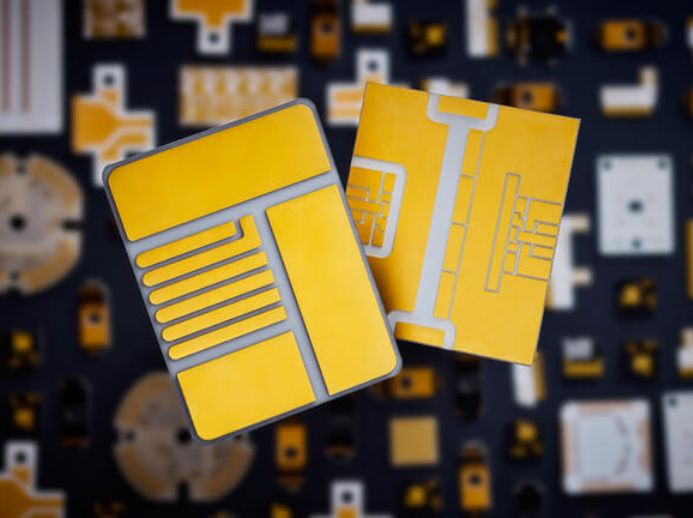
Silicon Nitride provides high mechanical strength, fracture toughness, and thermal stability. It is suitable for medical electronics exposed to mechanical shock, vibration, and repeated thermal cycling, including rugged diagnostic equipment and demanding power modules.

MedPCB supports your medical ceramic PCB projects with free DFM review. ContactMedPCB for an instant quote.

Case Study

Medical Ceramic PCB Cases

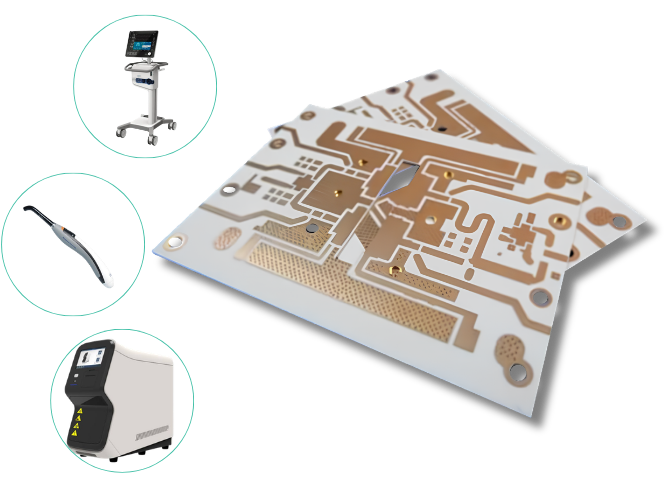
  • Hamilton Mechanical Ventilator 
    Hamilton Mechanical Ventilator  PCB Hamilton Mechanical Ventilator 

    Hamilton Mechanical Ventilator 

    High-end ICU ventilators that use ceramic boards to control high-speed blower turbine motors and precise gas-flow sensors.

  • LASIK Lasers 
    LASIK Lasers PCB LASIK Lasers 

    LASIK Lasers 

    Ultra-precise corneal refractive surgery laser requiring thermally stable ceramic boards to maintain laser beam alignment at the micron level.

  • Automated Molecular Analyzer 
    Automated Molecular Analyzer PCB Automated Molecular Analyzer 

    Automated Molecular Analyzer 

    Fully automated PCR system using microfluidic ceramic heating circuits to achieve exact thermal cycling temperatures for DNA/RNA amplification.

  • Ivoclar Bluephase PowerCure 
    Ivoclar Bluephase PowerCure PCB Ivoclar Bluephase PowerCure 

    Ivoclar Bluephase PowerCure 

    High-power LED dental curing light that uses direct-bond ceramic PCBs to pull extreme heat away from the high-intensity LED diode in a compact handpiece.

Faqs

Frequently Asked Questions

Our Medical Ceramic PCB FAQ addresses essential questions regarding your manufacturing requirements. We cover our capabilities for complex medical electronics, supply chain management, assembly timelines, rigorous quality inspection protocols, and our capacity to scale from initial builds to production batches. For every medical device project, we guarantee precision-focused, medical-grade assembly standards.

1. What Are the Advantages of Ceramic PCB over FR4 PCB?
Ceramic PCBs offer better thermal conductivity, temperature stability, and dimensional stability than FR-4. They also provide low dielectric loss and strong electrical insulation, making them suitable for high-power, high-frequency, and medical electronics.

2. What Is the Best Ceramic PCB Material for High Temperature Applications?
Aluminum Nitride is one of the best choices for high-temperature applications. It provides high thermal conductivity, low thermal expansion, and strong electrical insulation. 

3. How Are Ceramic PCBs Cut Or Shaped?
Ceramic boards are cut, profiled, and drilled using high-precision laser systems (such as fiber lasers). Because ceramics are brittle, traditional mechanical routing and drilling can cause cracking, chipping, or severe tool wear.

4. Can Ceramic Boards Have Plated Through Holes (PTH)?
Yes. We manufacture ceramic PCBs with plated through holes and interconnects using the Direct Plated Copper (DPC) process. Contact our engineering team for specialized designs requiring heavier copper weights.

5. What Is The Difference Between LTCC And HTCC Ceramic Materials?
LTCC (Low-Temperature Co-Fired Ceramic) uses glass-ceramic additives to fire at lower temperatures (around 850–950°C), making it ideal for cost-effective RF applications and 3D structures. HTCC (High-Temperature Co-Fired Ceramic) uses pure ceramics fired at 1500–1600°C, delivering significantly higher mechanical strength and thermal conductivity.

6. How Does High-Thermal-Conductivity PCB Manufacturing Differ From Standard PCBs?
High-thermal-conductivity manufacturing uses direct bonding techniques like DBC or AMB to attach copper to substrates at extreme temperatures, establishing a direct thermal path. Standard FR-4 manufacturing relies on organic resin curing, which offers far less thermal performance.

7. Why Choose Low-Dielectric-Constant Ceramics For High-Frequency Designs?

Low dielectric constant ceramics minimize signal delay, attenuation, and crosstalk in gigahertz-range medical electronics. Unlike organic FR-4 laminates, ceramic substrates resist moisture absorption and maintain stable electrical performance across wide temperature ranges.


8. Is Ceramic More Expensive Than FR-4?

Yes. Raw ceramic materials (such as AlN) and high-temperature metallization processes carry higher upfront costs than standard FR-4. However, their superior thermal management and long-term reliability make them necessary for life-critical medical devices.


Product Related