Shengyi SF305 Flex PCB Manufacturer

MedPCB manufactures SF305 flexible and rigid-flex bare boards designed for critical medical device projects.

• Genuine Shengyi SF305 Halogen-Free Polyimide FCCL
• UL 94 V-0 Flame Resistance 
• Flexible PCB up to 8 Layers & Rigid-Flex PCB up to 20 Layers
• ISO 13485 & IPC Class 2/3 Manufacturing

Shengyi SF305 Flex PCB Manufacturer
Certifications
What Is an SF305 PCB?
introduction

What Is an SF305 PCB?

An SF305 PCB is a flexible printed circuit built on Shengyi SF305, a halogen-free flexible copper-clad laminate (FCCL) that bonds copper foil to polyimide film. The SF305 laminate is rated UL 94 V-0, is RoHS compliant, and is paired with Shengyi SF305C coverlay, the insulating film applied over the finished polyimide flexible circuit.

SF305 carries a UL 94 V-0 rating and meets EU RoHS requirements. Its documented electrical and mechanical characteristics include a dielectric constant of 3.6 at 10 GHz, a dissipation factor of 0.028, and over 600 folding cycles under defined MIT test conditions.

MedPCB manufactures custom flex and rigid-flex PCBs using genuine Shengyi SF305 for medical electronics. We implement full material traceability and production controls aligned with your project requirements.

advantages

Key Advantages of Medical-Grade SF305 Flexible PCBs

  • Excellent Flexibility for Compact Medical Electronics
  • Halogen-Free & UL 94 V-0 Flame Resistance
  • Thermal Resistance & Dimensional Stability
  • Stable Electrical Insulation & Low Moisture Uptake
Excellent Flexibility for Compact Medical Electronics
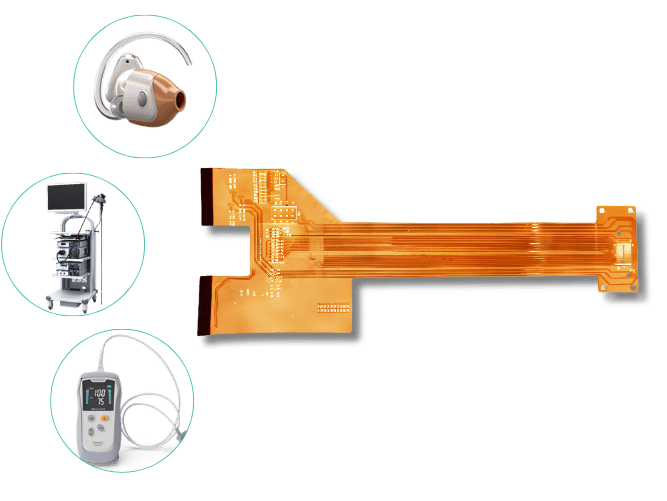
SF305 is designed for flexible circuit applications where the PCB must bend, fold, or conform to a compact device structure. Its flexibility supports space-constrained medical electronics such as wearable devices, compact sensors, and instrument interconnects.
Halogen-Free & UL 94 V-0 Flame Resistance
Thermal Resistance & Dimensional Stability
Stable Electrical Insulation & Low Moisture Uptake
Why Choose Us

Why Choose MedPCB?

  • ISO 13485 Certified TC350 PCB Production

    ISO 13485 Certified SF305 Flex PCB Production

    MedPCB manufactures SF305 flex and rigid-flex PCBs within an ISO 13485 and ISO 9001 certified quality management system. Production records, process controls, and material traceability support the documentation requirements of medical device manufacturing. We manufacture and inspect finished boards to meet applicable IPC-6013 Class 2 or Class 3 requirements.

  • Free DFM Review with RF Stackup & Material Consultation

    Free DFM Review with Flex Stackup

    MedPCB provides a complimentary DFM review to identify manufacturing risks before tooling release. Our engineers review the flex stackup, coverlay openings and pullback, bend zones, annular rings, copper weight, and etch compensation against your fabrication data. Any manufacturability concerns are raised for your review before production begins.

  • Rogers TC350 Material Sourcing

    Shengyi SF305 Material Sourcing

    MedPCB sources genuine Shengyi SF305 laminates directly from Shengyi Technology according to your specified construction. To ensure complete lot traceability, we maintain certificates of conformance, lot numbers, and current technical datasheets for every production run.

  • Advanced Hybrid Multilayer Capability with PTFE Laminates

    Flexible & Rigid-Flex PCB Manufacturing Capability

    MedPCB supports both SF305 flex and rigid-flex PCB manufacturing, allowing your project to use one qualified manufacturing partner across different circuit constructions. We manufacture up to 8-layer flex PCBs and up to 20-layer rigid-flex PCBs using SF305 flex materials with qualified rigid cores and prepreg.

  • Quality Control, Testing & Material Traceability

    Quality Control, Testing & Material Traceability

    MedPCB maintains full material traceability from incoming laminate rolls to final packaging, tracking every SF305 order to its specific production lot. Our rigorous quality control includes automated optical inspection, flying probe testing, IPC microsectioning, and impedance validation, accompanied by complete UL and REACH compliance documentation.

Specs

Technical Specifications

Capability Flex PCB Rigid-Flex PCB
Material Shengyi SF305 FCCL; Shengyi SF305C Coverlay Shengyi SF305 flex layers with qualified rigid PCB cores and prepreg
Layer Count Up to 8 layers Up to 20 layers
Board Thickness 0.5–0.8 mm (without stiffener) 0.3–4.0 mm
Board Size Min: 4 × 8 mm (without bridge)
Max: 9 × 23 in (for PI ≥ 1 mil)
Min: 10 × 15 mm
Max: 406.4 × 736.6 mm
Min. Bend Radius Single Layer: 3–6× board thickness
Double Layer: 6–10× board thickness
Multi-Layer: 10–15× board thickness
Dynamic Bend: 20–40× board thickness
Follows Flex PCB parameters
Surface Treatment HASL, ENIG, ENEPIG, Electrolytic Nickel Gold, Soft Gold, Hard Gold, Immersion Silver, Immersion Tin, OSP
Stiffeners & Adhesives Supports PI / FR4 stiffeners and qualified 3M-series bonding adhesives
Medical SF305 PCB
Process

Our Medical SF305 Flex PCB Production Process

Step 1: Engineering Review & Flex Stackup Verification
Every SF305 order begins with our comprehensive engineering review. We check your supplied data against the released drawing and verify the flex stackup for coverlay pullback, bend zone content, and copper rolling direction relative to the bend line. Our engineering team calculates etch compensation and artwork scaling based on your specified copper weight and film thickness, documenting both values on the production record before we release the tooling.
Step 2: Polyimide Material Preparation & Circuit Imaging
Step 3: Etching, Drilling & Plated Through-Hole Processing
Step 4: Coverlay Lamination & Surface Finish
Step 5: Electrical Testing & Final Inspection
challenges

Common Challenges in Medical SF305 Flex PCB Manufacturing

  • Flex Material Handling & Dimensional Stability

    Flex Material Handling & Dimensional Stability

    Unsupported polyimide absorbs moisture and relaxes after copper is etched away, which moves features away from the tooling datum. The result is annular ring breakout and coverlay misregistration, usually found at final inspection after plating and finishing.

    Our Solution: MedPCB bakes incoming SF305 before imaging, supports thin cores on pinned frames during wet processing, and scales artwork for copper weight and film thickness. Panels are measured against reference targets after etching, and that measured movement sets the scaling factor for the next lot.

  • Coverlay Alignment & Lamination

    Coverlay Alignment & Lamination

    Coverlay adhesive must fill the space beside each conductor without reaching the pad area, and the film stretches while it is placed. Adhesive on a pad causes solderability rejects, and insufficient flow leaves voids that retain process chemistry and cause corrosion.

    Our Solution: SF305C openings are cut and inspected before lay-up, placement is aligned optically to fiducial marks, and lamination uses a stepped vacuum cycle matched to the coverlay adhesive. Absence of voids beside conductors is confirmed by microsection, and pad cleanliness by automated optical inspection.

  • Dynamic Bending & Bend Radius

    Dynamic Bending & Bend Radius

    Repeated bending places mechanical stress on copper conductors and can lead to cracking when the bend radius, copper type, or stack-up is not properly selected. Dynamic applications therefore require careful control of copper type, conductor placement, bend radius, and bend-zone construction.

    Our Solution: MedPCB utilizes rolled annealed copper for dynamic medical applications, ensuring conductors are optimally placed near the neutral bending axis. We manufacture these boards by keeping plated holes and stiffener edges outside the bend zone, verifying folding endurance through IPC-TM-650 MIT folding tests.

  • Signal Integrity in Flexible Circuits

    Signal Integrity in Flexible Circuits

    The dielectric in a flex circuit is a thin film, so a small change in line width or coverlay thickness shifts impedance far more than on a rigid core. Impedance outside tolerance causes signal reflections and reduced margin, and it is usually found during device integration, too late for a rebuild.

    Our Solution: MedPCB calculates line geometry from the laminate values for the lot in production, controls trace width by controlled etching and measured first-article line width, and tests coupons by time domain reflectometry against the tolerances listed in the capability table. The coupon report is supplied with the lot.

Shengyi SF305 Material Specifications
Specifications

Shengyi SF305 Material Specifications

MedPCB manufactures SF305 circuits using halogen-free polyimide laminates that meet strict requirements for flame resistance, repeated folding, and stable insulation. The following table summarizes selected electrical, mechanical, dimensional, and thermal properties of Shengyi SF305 under the published test conditions.

Property Test Condition Typical Value
Dielectric Constant (10GHz) SPDR (C-24/23/50) 3.6
Dissipation Factor (10GHz) SPDR (C-24/23/50) 0.028
Volume Resistivity C-96/35/90 1.5 × 10^8 MΩ-cm
Dimensional Stability After Etched -0.0684 / 0.0691 %
Folding Endurance R0.8 × 4.9N > 600 times
Solder Resistance 288°C, 10s No delamination
Flammability E-24/125 V-0

Need an SF305 flex PCB for your medical device? Send your Gerber files for a Free DFM Review and Quote.

industries

Applications of Medical SF305 Flex PCBs

More Industries

Case Study

Medical SF305 Flex PCB Case Studies

  • SF305 Flex Circuit for Wearable ECG Patch
    SF305 Flex Circuit for Wearable ECG Patch SF305 Flex Circuit for Wearable ECG Patch

    SF305 Flex Circuit for Wearable ECG Patch

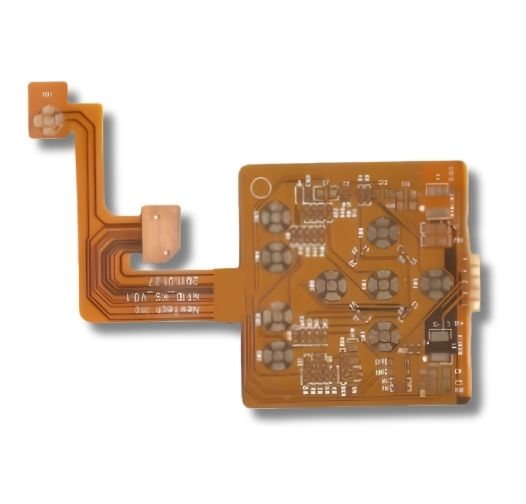
    This customer builds disposable ECG patches, and the circuit had to be formed to a curved adhesive housing without a connector. We produced a double-sided SF305 flex circuit with rolled annealed copper, SF305C coverlay set back from the formed bend, and ENIG finish on the electrode pads. Panels were inspected optically after etching and after lamination, then electrically tested against the supplied net list to IPC-6013 Class 2.

  • Double-Sided Flex PCB for Hearing Aid Module
    Double-Sided Flex PCB for Hearing Aid Module Double-Sided Flex PCB for Hearing Aid Module

    Double-Sided Flex PCB for Hearing Aid Module

    When presented with a strict 4 × 8 mm board outline limited by a pre-tooled housing, MedPCB manufactured the fine outer layer geometry on 18 µm copper and applied an ENEPIG surface finish for contact reliability. To protect the small polyimide circuit and maintain the required outline accuracy, we laser-profiled the board. The production lot was released only after passing Class 3 dimensional verification and continuity testing.

  • Dynamic Flex Interconnect for Surgical Robot Arm
    Dynamic Flex Interconnect for Surgical Robot Arm Dynamic Flex Interconnect for Surgical Robot Arm

    Dynamic Flex Interconnect for Surgical Robot Arm

    This customer's product required an interconnect that bends continuously through an articulating joint. We handled it with rolled annealed copper, a symmetric stackup that keeps conductors close to the neutral bending axis, no plated-through holes inside the bend zone, and a bend radius at the upper end of the published dynamic range. Microsection of the hole wall and coverlay adhesion completed release, together with continuity and isolation testing.

  • Flex Sensor Board for Continuous Glucose Monitor
    Flex Sensor Board for Continuous Glucose Monitor Flex Sensor Board for Continuous Glucose Monitor

    Flex Sensor Board for Continuous Glucose Monitor

    For this diagnostics customer, the governing requirement was stable leakage performance on a sensor tail worn against skin. We ran SF305 with soft gold on the sensor contacts, coverlay extended to the edge of the tail, and mechanical drilling at 0.10 mm. Checks completed before shipment: insulation resistance measurement, automated optical inspection, and microsection to IPC-A-600 Class 3.

Faqs

Frequently Asked Questions

Our Medical SF305 Flex PCB FAQ addresses key questions regarding Shengyi SF305 flexible laminate properties and fabrication standards. We cover flexible characteristics, UL 94 V-0 halogen-free flame resistance, insulation resistance, multilayer construction, lead-free reflow compatibility, surface finishes, and DFM support. For every medical SF305 flex PCB project, we guarantee high-precision manufacturing engineered for critical healthcare applications.

1. Is SF305 a Rigid or Flexible Laminate?
SF305 is a flexible laminate. It is a Shengyi flexible copper-clad laminate that bonds copper foil to a halogen-free polyimide film, used for flex circuits and the flex layers of rigid-flex boards.
2. Why Is SF305 Suitable for Medical Wearables?
SF305 suits medical wearables because it combines a UL 94 V-0 halogen-free base film with a volume resistivity of ≥ 10^6 MΩ·cm and low moisture absorption. Insulation resistance stays stable during skin contact.
3. Is SF305 Halogen-Free?
Yes. SF305 uses a halogen-free polyimide base film and is rated UL 94 V-0. MedPCB issues RoHS and REACH declarations for the laminate lot used on your order.
4. What Is the Difference Between SF305 and SF302?
Both are Shengyi flexible copper-clad laminates, differing in construction and in the properties published for each grade. Controlling values change between datasheet revisions, so MedPCB confirms current figures for both grades with Shengyi on request.
5. Can SF305 Be Used in Multilayer Flex PCBs?
Yes. MedPCB builds SF305 in flex constructions of 1-8 layers and rigid-flex constructions of 4-20 layers, with up to 18 flex layers.
6. What Is the Maximum Operating Temperature of SF305?
Shengyi does not publish a single maximum continuous operating temperature for SF305. The laminate withstands thermal stress testing at 300°C for 30 s without delamination and is compatible with lead-free processing, which describes process conditions rather than a continuous rating. Request the current datasheet revision from MedPCB.
7. What Surface Finishes Are Recommended for SF305 Flex PCBs?
ENIG and ENEPIG are the usual finishes for medical SF305 flex circuits, because both are flat and stable for fine geometry and wire bonding. Soft and hard gold suit electrode surfaces, and immersion silver, immersion tin, OSP, and HASL are available.
8. What Is the Minimum Trace Width and Spacing on SF305?
As part of our manufacturing capabilities, MedPCB produces 2.8 / 2.7 mil line and space on both inner and outer flex layers using 18 µm copper. For rigid-flex boards, our capabilities allow for 3.0 / 3.0 mil on inner layers and 3.2 / 3.6 mil on outer layers.
9. Are SF305 Flex PCBs Suitable for Repeated Sterilization?
SF305 is polyimide-based and withstands lead-free soldering temperatures, which indicates tolerance to autoclave temperature. Sterilization compatibility is a property of the finished construction, including coverlay, finish, and stiffener adhesive, so it must be qualified on the device.
10. Do You Provide Impedance Test Coupons for SF305 Flex PCBs?
Yes. MedPCB supplies time-domain reflectometry coupons whenever impedance is specified, reporting measured values against ±3Ω single-ended and ±4Ω differential at ≤50Ω, or ±8% above 50Ω.

Product Related