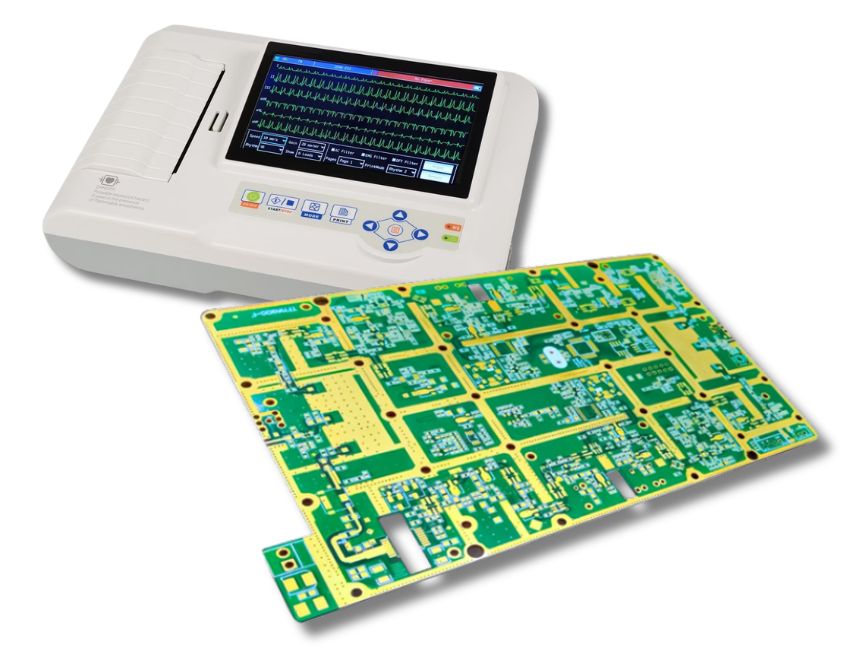
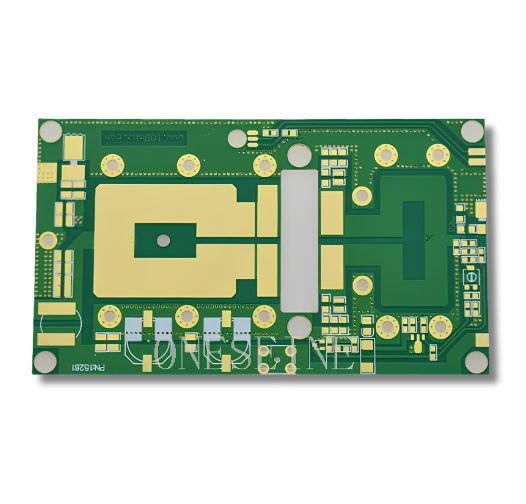
A medical high-frequency PCB is engineered to operate at high frequencies with minimal signal loss and ultra-low distortion. By utilizing specialized low-loss substrate materials, precise impedance control, and advanced layer stackups, we build high-speed circuit boards that maintain stable electrical performance in critical healthcare environments. This high-frequency construction is essential for modern medical devices, delivering the rapid data transmission, noise immunity, and uncompromised precision required for MRI systems, medical radar, wireless patient monitoring, surgical tools, and life-critical diagnostic equipment.
|
Technical Parameter |
Advanced High-Frequency Capability |
|
HF Materials |
Rogers RO4000/3000, Taconic TLY/RF, Megtron 6, Arlon, Isola Astra |
|
Layer Count |
Up to 40 layers for complex RF and high-speed designs |
|
Dielectric Thickness |
Down to 0.05 mm (2 mil) for thin, high-speed stack-ups |
|
Impedance Control |
±5% controlled impedance |
|
Minimum Trace / Spacing |
0.05 / 0.05 mm (2 / 2 mil) for dense RF routing |
|
Microvias |
0.1 mm laser-drilled microvias with stacked, staggered, and any-layer
HDI |
|
Via Filling |
Resin- or copper-filled and capped via-in-pad |
|
Via Aspect Ratio |
Up to 12:1 for reliable deep-via plating |
|
Surface Finishes |
ENEPIG, Immersion Silver, and Immersion Tin |
|
Heavy Copper |
Up to 100 oz for high-power and thermal applications |
|
Registration Accuracy |
±0.05 mm (2 mil) for accurate layer registration |

We review the Gerber files, layer stack-up, impedance requirements, and operating frequency. The design is checked for controlled impedance, dielectric thickness, trace geometry, and signal isolation. We also verify material compatibility before production.

Challenge: Small changes in trace width, etching, or dielectric thickness can affect impedance. This may cause signal loss, reflections, and data errors in high-frequency medical devices.
Our Solution: We use precision imaging, controlled etching, and impedance testing to maintain consistent high-frequency signal paths. Our engineering team reviews stack-up and impedance requirements during DFM.

Challenge: PTFE and ceramic materials have different flow characteristics during lamination. Poor control can lead to layer shifting, misregistration, voids, and inner-layer trace misalignment.
Our Solution: MedPCB supports multilayer high-frequency PCB fabrication with precise layer registration and controlled lamination processes. Our manufacturing team controls stack-up construction and layer alignment to maintain reliable electrical and mechanical performance.

Challenge: RF and microwave laminates can absorb moisture during storage and production. Moisture can change dielectric properties, affect signal stability, and increase the risk of delamination during assembly or sterilization.
Our Solution: We store high-frequency materials in climate-controlled areas and use controlled vacuum-baking processes before lamination. This helps keep materials dry and maintain stable electrical performance.

Challenge: Standard PCB tests may not detect signal loss, phase shifts, or impedance problems at gigahertz frequencies.
Our Solution: MedPCB uses impedance testers and advanced inspection equipment to verify high-frequency PCB quality. For demanding RF designs, our engineering team reviews controlled impedance requirements during DFM and production.

MedPCB maintains an extensive inventory of high-frequency laminates.
PTFE-Based Materials - PTFE laminates offer very low dielectric loss, low and stable Dk, and excellent high-frequency signal performance. They are well suited for RF and microwave circuits where signal integrity is critical. Our stocked PTFE-based materials include:
• Rogers RT/duroid 5880
• Rogers RO3003
• Shengyi mmWave77
• Taconic TLY Series
Non-PTFE Materials - Non-PTFE laminates provide low signal loss, good thermal stability, reliable mechanical strength, and easier PCB processing. They are a practical choice for high-speed and high-frequency medical systems that also require consistent manufacturing. Our stocked non-PTFE materials include:
• Rogers RO4003C
• Rogers RO4350B
• Panasonic Megtron 6
• Isola Astra MT77
MedPCB supports high-frequency medical PCB manufacturing with specialized materials, controlled impedance, DFM review, and IPC Class 2/3 production. Send us your Gerber files for a material and manufacturing review.
Our Medical High-Frequency PCB FAQ addresses essential questions regarding your manufacturing requirements. We cover our capabilities for complex medical electronics, supply chain management, assembly timelines, rigorous quality inspection protocols, and our capacity to scale from initial builds to production batches. For every medical device project, we guarantee precision-focused, medical-grade assembly standards.
English
French
German
Japanese
Korean