AI-Driven Wearable Medical Applications in Healthcare
-

-
August 30, 2026


AI-driven wearable medical devices move continuous monitoring onto the patient’s body. An AI-driven wearable medical PCB must survive skin contact, repeated flexing, and years of low-power operation. This article covers the applications, chipsets, and fabrication requirements.
Wearables track physiological status continuously, and machine learning improves accuracy. AI models can help identify patterns or anomalies in physiological data and support earlier clinical assessment or automated responses in appropriately validated systems.

These devices collect physiological signals and run machine learning models on that data. They classify events, flag anomalies, and predict deterioration instead of only logging numbers. Form factors include the smart patch flexible circuit, the smart ring, and the wristband.
Early wearables recorded steps and heart rate, then handed raw numbers to the user. A predictive monitor interprets the signal, compares it against learned patterns, and reports clinical meaning. That shift raises performance demands on the smart healthcare circuit board underneath.
AI algorithms process wearable health data and generate inferences quickly enough to act on. Clinicians decide without waiting for a scheduled visit. The device can alert a caregiver, escalate to emergency services, or command a drug delivery pump.
AI wearables serve four clinical roles: remote patient monitoring, early diagnosis, chronic disease management, and emergency event detection. Each role places different sampling, accuracy, and power constraints on the electronics.

Remote patient monitoring keeps a clinician informed without an in-person visit. The wearable samples vital signs, applies AI models locally, and transmits exceptions. Patients with hypertension, heart failure, and diabetes benefit most. An AI remote patient monitoring PCB must run for days between charges.
AI combined with acoustic detection supports remote cardiac monitoring. The device captures heart sounds and biopotential signals, then classifies murmurs and arrhythmias. A wearable ECG circuit board carries microvolt signals, so grounding, guarding, and shielding decide accuracy.
Some closed-loop systems combine continuous glucose monitoring with insulin delivery and control algorithms to adjust insulin delivery based on glucose measurements. AI models forecast glucose trajectory and adjust dosing early. This closed loop makes hardware faults a direct patient risk. The PCB assembly should meet the class and acceptance criteria defined by the device risk assessment and applicable manufacturing specifications.
AI wearables help blind and visually impaired users navigate and avoid obstacles. Image sensors and edge inference identify hazards, then convey them through audio or haptic feedback. Other devices help deaf users perceive environmental sounds.
Emergency detection covers falls, seizures, cardiac arrest, and severe hypoglycemia. An AI diagnostic wearable PCB must stay awake, sense reliably, and transmit without delay, which strains the power budget.
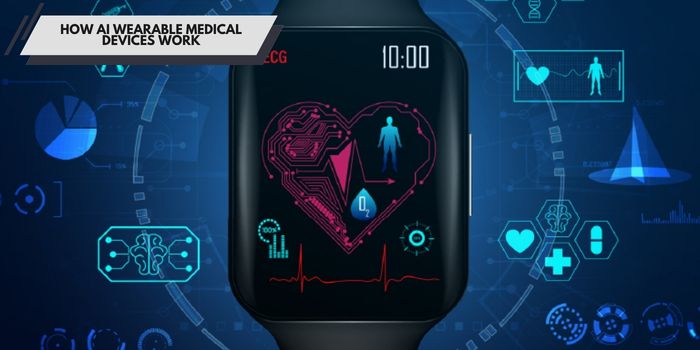
An AI wearable follows a fixed signal chain. Sensors acquire the signal, an analog front end conditions it, a processor runs the model, and a radio transmits results. A power management stage supports all of it.
Optical sensors measure heart rate and oxygen saturation through photoplethysmography. Biopotential electrodes capture ECG, EEG, and EMG activity. A bio-impedance sensor PCB tracks body composition and respiration. Motion sensors supply activity context and correct for movement.
The analog front end amplifies, filters, and digitizes signals measured in microvolts. On a biometric sensor PCB, the AD8233 handles ECG in one package, and the ADPD4100 and ADPD4101 serve optical and electrochemical sensing. Noise introduced here propagates downstream.
An ultra-low-power microcontroller or DSP runs the inference model on the device. The ADuCM3029 pairs a Cortex-M3 core with integrated power management and 256 KB of flash. A machine learning medical PCBA cuts latency locally, but concentrates heat in a small area.
Bluetooth Low Energy carries most wearable traffic to a phone or gateway. Sub-GHz transceivers such as the ADF7030 and ADF7030-1 cover longer-range links. A wireless telemetry medical PCB needs a controlled-impedance feed and adequate antenna keepout.
A coin cell or small lithium-polymer cell powers the entire system. The ADP530 buck regulator delivers 150 mA or 500 mA at very low quiescent current. Power management ICs on a miniaturized medical telemetry board sequence rails and gate unused blocks.
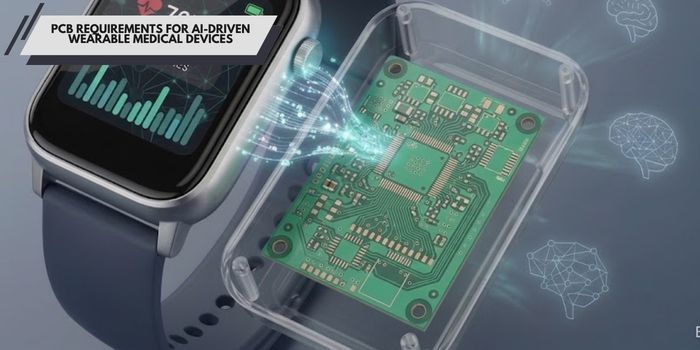
An AI-driven wearable medical PCB combines tight miniaturization with medical-grade reliability. You need high-density interconnect, flexible substrates, controlled impedance, and low-leakage power distribution on the same board.
Wearable enclosures leave little internal volume, so miniaturized PCB medical wearables populate both sides at fine pitch. HDI construction with stacked and staggered microvias routes dense BGA packages in a small footprint.
Wearables wrap around wrists, chests, and ears, so a flat rigid board rarely fits. A flexible circuit bends to the body contour and removes connectors from the assembly.
Biopotential signals sit in the microvolt range, and switching regulators generate noise orders of magnitude larger. Solid reference planes and separated analog and digital regions protect accuracy.
An ultra-low power medical PCB cannot dissipate much heat, and skin contact caps allowable surface temperature. Thermal vias, copper spreading, and careful placement pull heat away from the processor. Small boards leave no room for heatsinks.
Antenna performance drops quickly when copper, batteries, or shielding cans sit too close. The stackup must provide a controlled-impedance feed line and a clear keepout under the radiator.
Optical sensors, electrodes, and MEMS packages need precise placement to contact or view the body correctly. Wafer-level and chip-scale packages arrive at 0.35 mm pitch or finer. In wearable biosensor PCB assembly, stencil design and reflow profile determine yield.
Material choice decides whether a wearable board survives flexing, sweat, and years of skin contact. Medical-grade flexible printed circuits rely on polyimide, HDI stackups, and controlled finishes. Process control matters as much as the material.
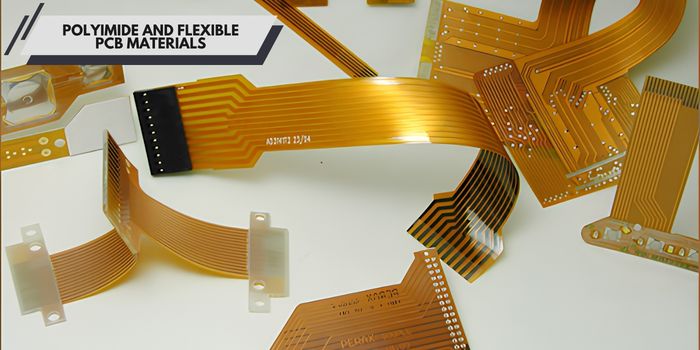
Polyimide survives repeated bending and reflow, but absorbs moisture, so pre-bake panels before assembly. Specify adhesiveless laminates such as Pyralux AP or Panasonic Felios to cut z-axis expansion and tighten bend radius. Use rolled annealed copper at 12 µm or less in dynamic flex zones.
HDI construction uses laser-drilled microvias to connect adjacent layers and provide dense routing for fine-pitch components. Microvia diameter and pad size depend on the fabricator’s process capability and the required stackup. Sequential lamination can support multiple microvia structures for dense BGA escape routing.
ENIG gives a flat, oxidation-resistant surface suited to fine-pitch and BGA assembly. ENEPIG adds palladium for wire bonding and better corrosion resistance. Parylene and acrylic conformal coatings protect against sweat and humidity.
We review your files before fabrication and report anything that threatens yield. Typical findings include unrealistic bend radii, insufficient annular ring, and coverlay clearance errors. You keep full ownership of the design, and we recommend the correction.
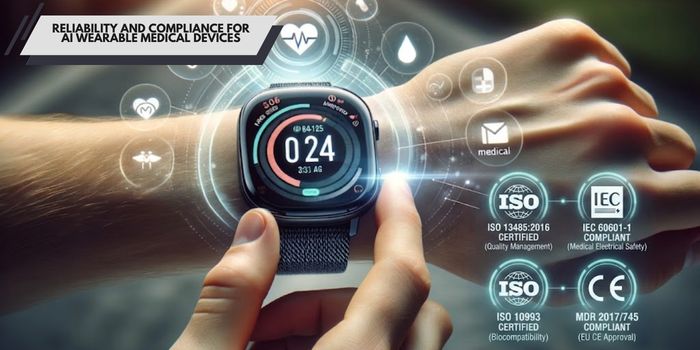
A high-reliability smart wearable PCB must satisfy safety, EMC, biocompatibility, and quality system requirements before it reaches patients. MedPCB builds under a documented quality system and supplies the evidence you need.
IEC 60601-1 governs basic safety, including creepage and clearance on the board. IEC 60601-1-2 covers electromagnetic compatibility, both emissions and immunity. Wearables face interference from phones, wireless chargers, and hospital equipment.
ISO 10993 defines biological evaluation for materials that touch the patient. Any exposed conductor, coating, or adhesive in the skin contact path falls under that scope. MedPCB documents material certifications for every lot we ship.
Sweat carries salt and reaches pH levels that corrode copper and degrade solder mask. Conformal coating and potting seal vulnerable areas without adding much thickness. We measure ionic contamination and record the result for each build.
Dynamic flex sections can require tens of thousands of bend cycles across device life. Bend radius, copper thickness, and neutral axis placement determine cycle count. MedPCB runs bend cycle testing when your specification calls for it.
Wearable PCBA production runs under an ISO 13485 quality management system, with build and inspection to IPC-A-610 and J-STD-001 Class 3 criteria. Lot traceability extends from raw laminate through final electrical test.
Wearables transmit protected health information, so hardware must support secure boot and encrypted storage. Secure elements and MCUs with cryptographic accelerators provide that foundation. An FDA-compliant wearable PCBA still leaves AI model validation with you, since regulators treat the algorithm as software.
Five component groups define an AI medical device PCBA: sensors and analog front ends, processors, radios, power management ICs, and motion sensors. MedPCB sources these parts through authorized channels.
Optical and biopotential front ends define the signal quality of the whole device. Multi-mode optical AFEs such as the ADPD4100 drive LEDs and reject ambient light for PPG channels, while ECG-class amplifiers like the AD8233 handle high common-mode rejection and low input-referred noise. Judge parts on noise density and LED drive efficiency, not feature count.
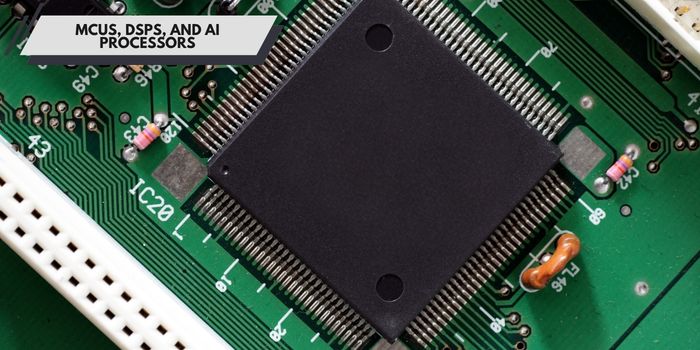
The processor sets both battery life and how much inference runs on-device. Ultra-low-power Cortex-M parts like the ADuCM3029 suit threshold detection and sensor management, whereas neural network inference needs DSP extensions or a dedicated accelerator plus enough SRAM for model weights. Dedicated audiology DSPs remain the benchmark for hearing aid power budgets.
Pre-certified modules save months of compliance work. A combined Wi-Fi and Bluetooth 5.2 module such as Murata’s Type 1XL fits bedside-class devices, while skin patches and glucose meters usually need only BLE. Prioritize module footprint, FCC and CE pre-certification, and available antenna clearance over raw throughput specifications.

Wearables spend most of their life idle, so quiescent current matters more than peak efficiency. A buck regulator with ultra-low quiescent draw handles the digital rails, a separate LDO keeps switching noise off the analog front end, and coin-cell designs need adequate peak current headroom for radio transmit bursts.
Accelerometers do double duty: activity classification and motion artifact cancellation in optical channels. Low-noise, low-drift three-axis devices support gait and fall detection, while ultra-low-power parts with selectable ranges suit always-on wake detection. Skin temperature and humidity sensors add context that improves algorithm accuracy without meaningful power cost.
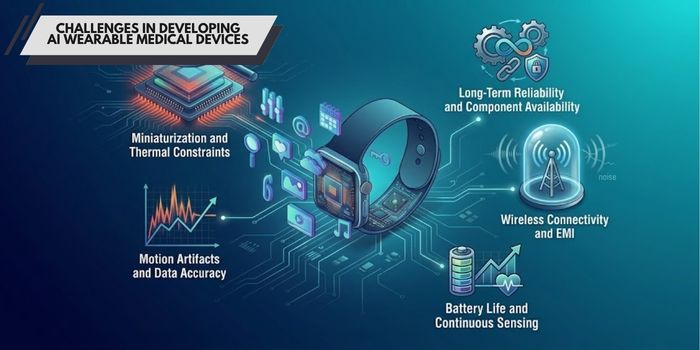
Five constraints dominate wearable medical development: battery life, motion artifacts, thermal limits, wireless interference, and long-term component availability. Each one traces back to decisions during fabrication and assembly.
Continuous sensing and on-device inference drain a small cell quickly. Duty cycling, hardware sequencers, and event-driven wake schemes cut average current on a continuous patient monitoring PCB. Clean fabrication and post-assembly cleaning protect the power budget.
Body movement corrupts optical and biopotential measurements. AI models remove much of the artifact using accelerometer data as reference. Electrode contact quality, shielding, and low-noise routing reduce the artifact at the source.
Shrinking the board raises power density and limits heat spreading options. IEC 60601-1 defines temperature limits for applied parts based on the type and duration of patient contact. Thermal vias and copper spreading handle the cooling.
Radios sit centimeters away from microvolt sensor circuits inside a wearable. Transmit bursts can couple into the analog path and corrupt readings. We fabricate to your keepout and shielding requirements and verify shield continuity.
Medical products stay on the market for a decade or longer, while semiconductor lifecycles run shorter. An obsolete part can force requalification and a new regulatory filing. MedPCB tracks component status across your bill of materials.

MedPCB specializes in PCB manufacturing and assembly for medical electronics, supporting OEMs from prototype through volume production. Our ISO 13485 certification sits alongside ISO 9001, UL, RoHS, and REACH compliance. Fabrication, assembly, and verification run through one qualified supplier, so there are no handoffs between board shop and assembler. That scope covers wearable medical electronics contract manufacturing and smart ring PCB fabrication, from prototype flex panels through validated production builds.
Ready to start your next project? Send us your Gerber files, and we will return a project review and quote.
A flexible PCB conforms to the body, so the device sits comfortably against the skin. They eliminate connectors and cables, which removes common failure points. You also save internal height.
Polyimide handles the flexible sections, and high-Tg FR-4 suits the rigid islands. Adhesiveless laminates with rolled annealed copper improve bend performance. ENIG and ENEPIG finishes resist corrosion from sweat.
On-device inference raises processor current draw during each computation. It lowers total consumption by cutting radio transmissions, which usually dominate the power budget. Duty cycling remains essential.
Yes. The FDA and EU MDR treat most of them as medical devices, and the AI algorithm falls under software as a medical device rules. Manufacturing must follow ISO 13485.
AI wearables monitor patients continuously and predict deterioration earlier. Each depends on sensors, an analog front end, a processor, a radio, and a tight power budget. An AI-driven wearable medical PCB carries that in HDI, flex, or rigid-flex form under ISO 13485 Class 3 standard.


Professional PCB







English

French

German

Japanese

Korean