Rogers 4350B for Medical PCBs

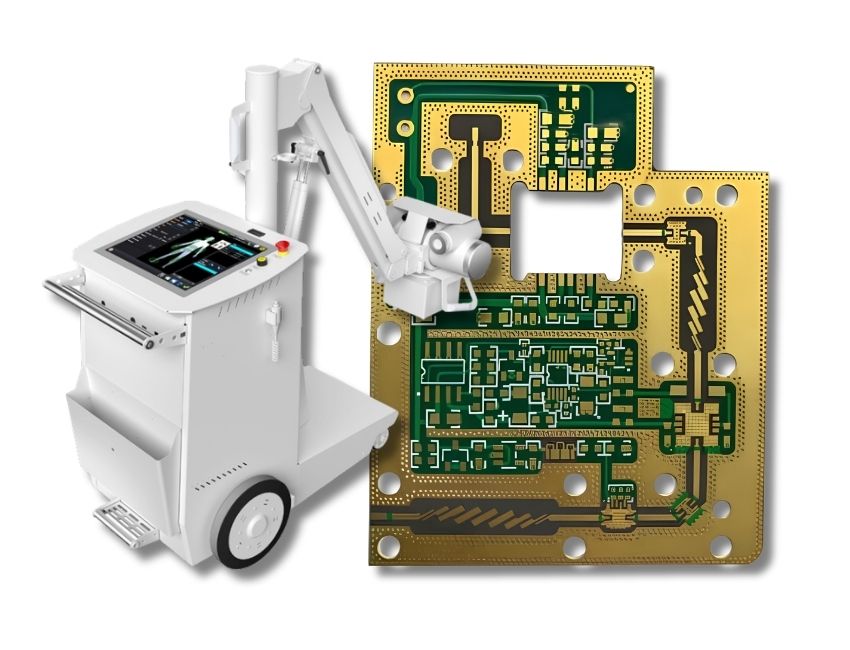
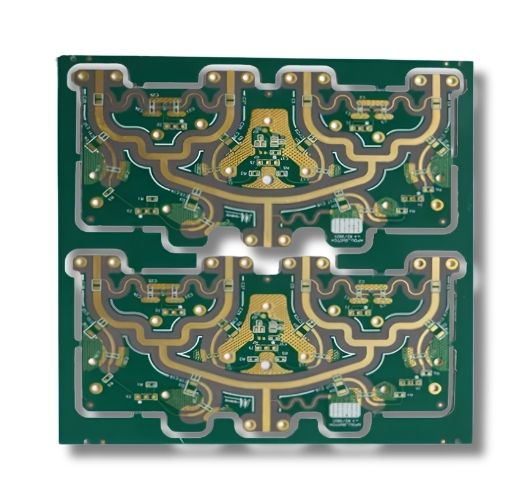
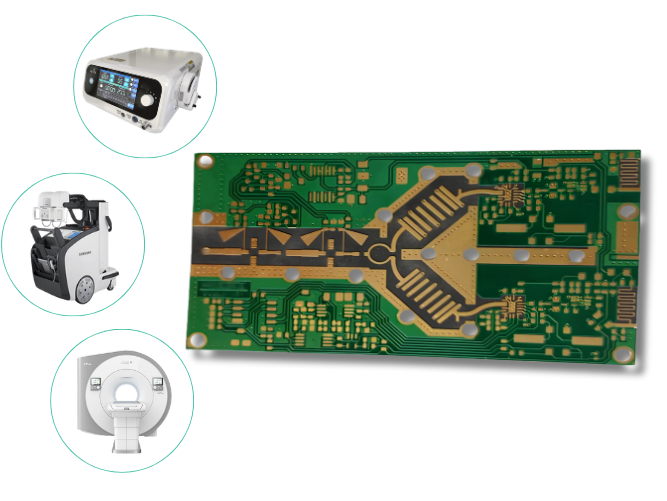
RO4350B is a high-frequency hydrocarbon/ceramic laminate known for low dielectric loss, controlled Dk, and dimensional stability. These properties make it suitable for medical PCBs used in RF, microwave, wireless, and high-speed signal applications. MedPCB manufactures RO4350B PCBs for prototypes, low-volume, and high-volume medical equipment needs.

• Dielectric Constant of 3.48 +/- 0.05 
• Dissipation Factor of 0.0037 at 10 GHz 
• Low Z-axis CTE at 32 ppm/°C
• ISO 13485 & IPC Class 2/3 PCB Manufacturing
Rogers 4350B for Medical PCBs
Certifications
Rogers 4350B PCB
introduction

What is Rogers 4350B for Medical PCB?

Rogers 4350B is a high-frequency PCB laminate designed for applications that require stable electrical performance and low signal loss. It provides tight control of dielectric constant (Dk) for consistent signal transmission. 

RO4350B uses standard FR-4-style PCB processing, making it easier to manufacture than many PTFE-based materials. RO4350B does not require the complex handling or special through-hole processes of PTFE materials. It holds a UL 94 V-0 safety rating, making it ideal for high-power RF uses and active medical devices. Rogers 4350B is used in medical electronics that require reliable high-frequency performance, controlled impedance, and stable operation.

MedPCB manufactures medical PCBs using Rogers 4350B for prototypes, low-volume, and volume production. We support HDI, multilayer, rigid, and other medical PCB designs based on your device requirements.

Quality

Rogers 4350B Advantages on Medical PCB Manufacturing

  • Similar Processing with FR4 
  • Improved Dimensional Stability
  • Low Loss and Controlled Dielectric Performance
  • Multilayer PCB Compatibility
  • UL 94 V-0 Flame Rating
Similar Processing with FR4 
RO4350B works with standard epoxy‑glass PCB manufacturing workflows for medical applications. This reduces the need for specialized processing associated with some PTFE-based materials and supports cost-efficient fabrication.
Low Loss and Controlled Dielectric Performance
Improved Dimensional Stability
Multilayer PCB Compatibility
UL 94 V-0 Flame Rating
Why Choose Us

MedPCB as Rogers 4350B Medical PCB Partner

  • ISO 13485 Certified Halogen-Free PCB Production

    ISO 13485-Certified Medical PCB Manufacturing

    Our medical PCB production follows ISO 13485 and supports IPC Class 2 and Class 3 requirements. Controlled processes, inspection records, and production traceability help maintain consistent PCB quality.

  • In-Stock Rogers 4350B Materials

    In-Stock Rogers 4350B Materials

    We work with established material suppliers to source genuine Rogers 4350B laminates for prototype and production orders. This helps reduce material sourcing delays and supports faster manufacturing schedules.

  • Rogers Hybrid Stackup and Lamination Capability

    Rogers Hybrid Stackup and Lamination Capability

    We support RO4350B hybrid stackups with compatible FR-4 cores and prepreg. Our lamination process controls layer registration, dielectric thickness, and bonding conditions to maintain the electrical and mechanical performance required by the approved stackup.

  • Advanced Rogers 4350B PCB Manufacturing Capabilities

    Advanced Rogers 4350B PCB Manufacturing Capabilities

    Our Rogers 4350B processes include precision drilling, reliable via plating, controlled impedance fabrication, and multilayer lamination. These processes support high-frequency medical PCBs with complex layer structures.

  • Free DFM Check for Rogers 4350B PCB

    Advanced Rogers 4350B PCB Manufacturing Capabilities

    Advanced Rogers 4350B PCB Manufacturing Capabilities

    Advanced Rogers 4350B PCB Manufacturing Capabilities

    Our engineering team reviews stackup, trace geometry, dielectric thickness, drilling, impedance requirements, and material combinations before fabrication. This helps identify manufacturability risks early and reduce avoidable redesigns.

Specs

Technical Specifications

Technical Parameter

Manufacturing Capability

Order Quantity

≥ 1 PCS

Quality Grade

IPC-6012 Class 2 & Class 3

Board Size

Standard: up to 500 × 600 mm; Advanced: up to 1100 × 500 mm

Layer Count

1–40 layers. Standard: 1–20 layers; Advanced: 22–40 layers, including hybrid stackups

Board Thickness

0.2–10.0 mm. Standard: 0.2–3.2 mm; Advanced: 3.4–10.0 mm

Copper Thickness

17–350 μm (0.5–10 oz). Standard: 0.5–4 oz

Min. Trace Width / Spacing

Internal: 3/3 mil (0.075 mm). External: 3/3 mil advanced; 3.5/4 mil standard, depending on copper weight

Surface Finish

ENIG, ENEPIG, HASL Lead-Free, OSP, Immersion Silver, Immersion Tin, Flash Gold, Hard Gold, Soft Gold, and combination finishes

Impedance Tolerance

±5 Ω for <50 Ω; ±10% for ≥50 Ω

Quality Inspection

AOI, TDR impedance testing, Hi-Pot testing, X-Ray inspection, and microsection analysis

Compliance

ISO 13485, ISO 9001, RoHS, REACH, and IPC-6012

Get Instant Quote
Technical Specifications Rogers 4350B PCB
Capabilities

Rogers 4350B PCB Manufacturing Process on MedPCB

Step 1: Engineering Review & Stackup Planning

We review your Rogers 4350B PCB design, layer count, impedance requirements, and material combination. The engineering team plans the stackup and checks trace geometry, dielectric thickness, and layer structure before production.

Step 2: Material Preparation & Inner Layer Fabrication
Step 3: Hybrid Lamination, Drilling & Copper Plating
For hybrid designs, Rogers 4350B can be combined with compatible FR-4 materials. We control lamination temperature, pressure, heating, and cooling to support reliable bonding and reduce internal stress. Drilling and copper plating are then performed to create reliable vias and electrical connections for multilayer medical equipment PCBs.
Step 4: Outer Layer Fabrication & Surface Finish
The outer layers are imaged and etched to form the final circuit pattern. AOI and other in-process inspections verify circuit features before surface treatment. We then apply the specified surface finish, such as ENIG, ENEPIG, or lead-free HASL.
Step 5: Final Inspection
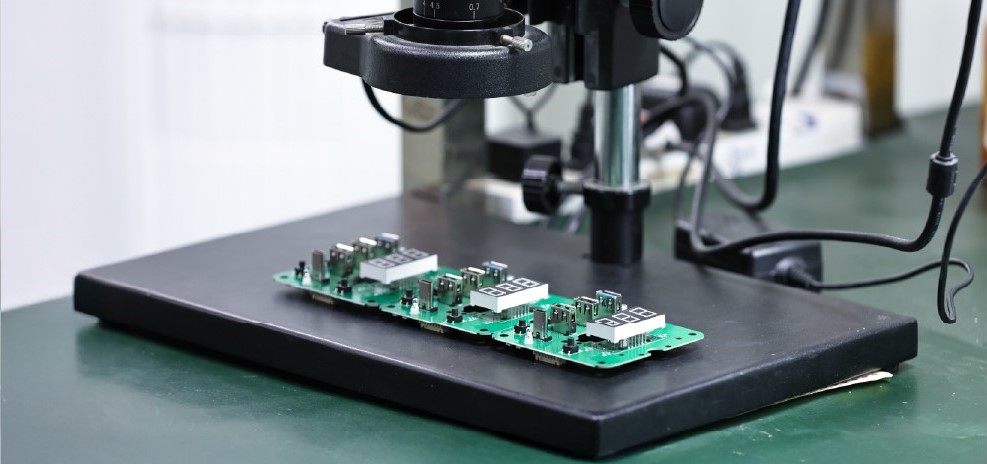
Final inspection can include AOI, X-ray inspection, electrical testing, and controlled-impedance and/or flying probe testing. These checks help verify the reliability and signal performance required for medical equipment operating in demanding applications.
Quality Control

Challenges in Medical PCB Fabrication using Rogers 4350B

  • Rogers 4350B Material Availability

    Rogers 4350B Material Availability

    Challenge: Demand for RF and microwave materials has increased, especially with the growth of AI and high-frequency electronics. This can make Rogers 4350B harder to source and may extend production lead times.

    Our Solution: We maintain in-stock Rogers materials for common PCB projects. If the specified material is unavailable, our engineers can review suitable alternatives with similar electrical and thermal performance during the DFM review.

  • Controlled Impedance and Fine-Line Fabrication

    Rogers 4350B Material Availability

    Challenge: Medical RF and high-speed equipment often requires precise impedance and fine-line routing. Small changes in trace width, spacing, copper thickness, or dielectric thickness can affect signal performance.

    Our Solution: We review impedance requirements during engineering and DFM checks. Our fabrication process controls trace geometry, dielectric thickness, copper plating, and layer registration to achieve the specified impedance tolerance across the board.

  • CTE Mismatch in Hybrid Multilayers

    CTE Mismatch in Hybrid Multilayers

    Challenge: Rogers 4350B is often combined with FR-4 in hybrid multilayer PCBs. The two materials have different thermal expansion rates. Poor process control can lead to warping, delamination, or stress on plated through-holes during thermal cycling.

    Our Solution: We review the hybrid stackup and control lamination temperature, pressure, heating, and cooling during DFM review. Proper stackup planning helps reduce thermal stress and maintain reliable multilayer construction.

  • Copper Adhesion and Surface Control

    Copper Adhesion and Surface Control

    Challenge: Rogers 4350B has different copper adhesion characteristics from conventional FR-4. Excessive etching or aggressive chemical treatment can weaken copper bonding and increase the risk of lifted traces or pads.

    Our Solution: We control surface preparation, chemical processing, and etching parameters for Rogers 4350B. This helps maintain copper adhesion and reliable circuit patterns through assembly and rework.

Rogers 4350B Material Specifications
Specs

Rogers 4350B Material Specifications

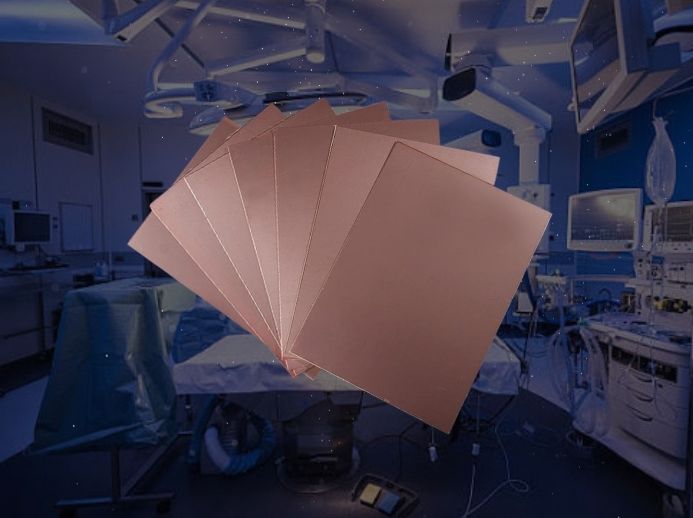
Rogers 4350B is a high-frequency laminate for medical PCBs that require low signal loss, stable electrical performance, and reliable thermal properties. The key specifications are shown below.

Rogers 4350B Property

Specification

Process Dk

3.48 ± 0.05

Design Dk

3.66

Dissipation Factor (Df) @ 10 GHz

0.0037

Thermal Conductivity

0.69 W/m·K

X - Axis CTE

10 ppm/°C

Y- Axis CTE

12 ppm/°C

Z-Axis CTE

32 ppm/°C

Water Absorption

0.05%

Peel Strength

5.0 lb/in (0.88 N/mm)

Tg

>280°C

UL 94 Flammability Rating

V-0

Compatibility with Lead-Free

Yes

MedPCB supports medical PCB projects, manufactured using Rogers materials, including Rogers 4350B. We offer free DFM review and IPC Class 2/3 manufacturing. We help select suitable materials and processes for reliable, high-frequency medical electronics.

Case Study

Rogers 4350B PCB Cases in Medical Equipments

  • Rogers 4350B Material Availability
    MRI Machines PCB MRI Machines 

    MRI Machines 

    The customer required stable high-frequency performance for MRI signal processing. MedPCB fabricated a multilayer RO4350B PCB with controlled impedance, fine trace spacing, and precise layer registration. The finished boards passed electrical and dimensional inspections.

  • Controlled Impedance and Fine-Line Fabrication
    Telemetry Transmitter PCB Telemetry Transmitter 

    Telemetry Transmitter 

    For reliable RF data transmission, the customer needed a compact, low-loss PCB. MedPCB produced a RO4350B board with controlled impedance and precise RF routing. The completed boards passed electrical testing and inspection.

  • CTE Mismatch in Hybrid Multilayers
    Microwave Ablation System PCB Microwave Ablation System 

    Microwave Ablation System 

    High-frequency energy control was the main requirement for this project. MedPCB manufactured a multilayer RO4350B PCB with controlled impedance and reliable plated vias. The finished boards passed quality and electrical testing.

  • Copper Adhesion and Surface Control
    Ultra-Wideband Radar PCB Ultra-Wideband Radar 

    Ultra-Wideband Radar 

    The customer needed a low-loss PCB for wideband radar signal processing. MedPCB fabricated a RO4350B board with precise RF routing and controlled dielectric properties. The completed board passed impedance and dimensional inspections.

  • X-Ray Machines 
    X-Ray Machines PCB X-Ray Machines 

    X-Ray Machines 

    This project required reliable signal processing and equipment control. MedPCB produced a RO4350B multilayer PCB with controlled impedance and stable layer construction. The finished boards passed electrical and quality inspections.

Faqs

Frequently Asked Questions

Our Medical Rogers 4350B PCB FAQ addresses essential questions regarding your eco-friendly manufacturing requirements. We cover our capabilities for multilayer halogen-free circuits, material selection, thermal stability, strict ISO 13485 quality standards, and compliance with RoHS and REACH regulations. For every medical PCB project, we guarantee high-precision fabrication tailored for critical healthcare applications.

1. Can RO4350B Be Combined with FR-4 in Hybrid PCB Stackups?
Yes. RO4350B is compatible with FR-4 in hybrid multilayer stackups and can be processed using standard PCB manufacturing methods.
2. Can MedPCB Manufacture Hybrid RO4350B and FR-4 PCBs?
Yes. MedPCB manufactures hybrid RO4350B and FR-4 PCBs for medical and high-frequency applications. Our engineering team reviews the stackup, material combination, impedance requirements, and lamination conditions before production.
3. Is RO4350B Suitable For 5G And Millimeter-Wave Applications?
Yes. RO4350B supports high-frequency applications up to about 40 GHz and is widely used for 5G RF designs.
4. What Makes RO4350B Different From PTFE-Based Materials?
What Makes RO4350B Different From PTFE-Based Materials?
RO4350B uses a hydrocarbon/ceramic material system and can be processed with standard FR-4 methods. This can reduce fabrication complexity and cost.
5. Does RO4350B Require Special Handling During PCB Fabrication?
RO4350B does not require the special handling and through-hole treatments commonly needed for PTFE-based laminates. Controlled drilling and lamination are still important for reliable results.
6. Does Rogers RO4350B meet UL Flammability Ratings?
Yes. RO4350B is UL 94 V-0 rated, providing flame-retardant performance for electronic applications.
7. Can Rogers RO4350B Laminates Withstand Lead-Free Soldering?
Yes. RO4350B can withstand lead-free reflow temperatures up to approximately 260°C and repeated soldering cycles.

Product Related