Surgical Robot PCB

MedPCB provides precision PCB manufacturing and assembly for surgical robotic systems. We support HDI, rigid-flex, heavy-copper and controlled-impedance PCB fabrication, together with fine-pitch SMT and mixed-technology assembly for robotic control, imaging, sensing, and power electronics.

✓ HDI, Rigid-Flex, and Heavy Copper PCB Manufacturing
✓ Fine-Pitch SMT & Mixed-Technology PCBA
✓ Component Sourcing, Inspection, Traceability & Functional Testing            
✓ ISO 13485 Manufacturing & IPC Class 2/3 Support

Surgical Robot PCB
Certifications
What is Surgical Robot PCB
introduction

What is Surgical Robot PCB?

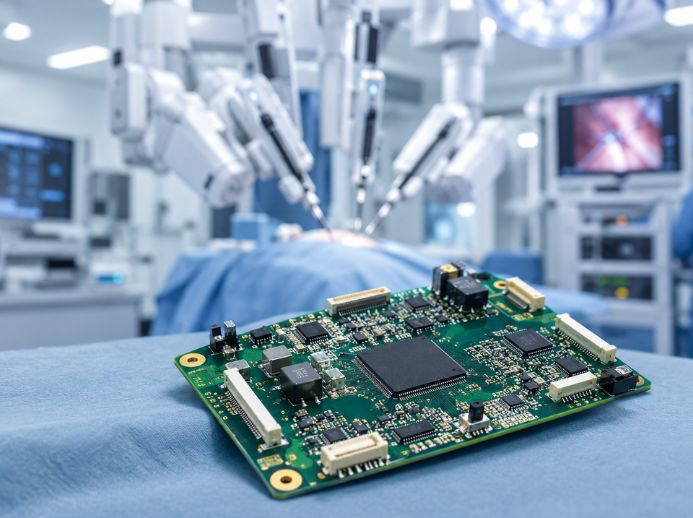
A surgical robot PCB is a specialized circuit board used in robotic surgical equipment. It connects and controls electronic components that support functions such as motor control, power management, sensor feedback, imaging, communication, and robotic arm movement.

Surgical robot electronics must provide precise and stable performance during operation. Depending on the system design, the PCB may require HDI construction, fine-pitch components, high-speed signal routing, rigid-flex circuits, or heavy copper for higher current loads.

MedPCB manufactures and assembles PCBs for surgical robotic systems under an ISO 13485 quality management system. We support prototype, low-volume, and volume production according to your-approved fabrication, assembly, inspection, and testing requirements.

Products

Key Features of Surgical Robot PCB & PCBA

  • HDI, Miniturization, and Electromagnetic Compatibility
  • Flex and Rigid-Flex PCB Construction
  • Signal Integrity & High-Speed Data
  • Advanced Thermal Management
HDI, Miniturization, and Electromagnetic Compatibility
Surgical robot electronics often require high component density within limited board space. HDI structures, microvias, and fine-line fabrication support compact PCB layouts. Controlled stackups and grounding also help manage electromagnetic interference in sensitive circuits.
Flex and Rigid-Flex PCB Construction
Signal Integrity & High-Speed Data
Vision, processing, communication, and control modules can require high-speed data transmission between devices and subsystems. Controlled-impedance multilayer PCB structures and qualified low-loss materials can support project-specific high-speed interconnect requirements.
Advanced Thermal Management
Why Choose Us

Why Choose MedPCB for Surgical Robot PCB Manufacturing & Assembly?

  • ISO 13485 Certified Manufacturing

    ISO 13485 PCB & PCBA Manufacturing

    MedPCB manufactures and assembles medical-grade PCBs under an ISO 13485 quality management system. Our process supports controlled production, material traceability, inspection, and testing for surgical robot electronics from prototypes to volume manufacturing.

  • Flex & Rigid-Flex PCB Manufacturing

    Flex & Rigid-Flex PCB Manufacturing

    We manufacture flex and rigid-flex PCBs for robotic systems with compact layouts and moving connections. These PCB structures support flexible routing and reliable connections in robotic arms and other space-limited assemblies.

  • Heavy Copper, High-Tg & High-Power PCB Capability

    Heavy Copper, High-Tg & High-Power PCB Capability

    We manufacture PCBs using heavy copper and high-Tg materials for applications with higher current loads and thermal demands. Thermal vias, copper planes, and suitable board structures help manage heat from motors, power circuits, and other high-power components.

  • Precision PCBA & Turnkey Component Sourcing

    Precision PCBA & Turnkey Component Sourcing

    MedPCB provides precision SMT, THT, and mixed-technology PCBA for surgical robotic electronics. Our 8 SMT assembly lines support fine-pitch packages, miniature components, and high-speed devices. Turnkey assembly includes component sourcing, PCB assembly, inspection, and functional testing based on your requirements.

  • Free DFM / DFA Check

    Free DFM / DFA Check

    Our engineering team reviews PCB layout, component placement, spacing, vias, materials, and assembly requirements before production. This helps identify manufacturing issues early and supports reliable surgical robot PCB and PCBA production.

Specs

Technical Specifications

Technical Parameter

Manufacturing Capability

Order Quantity

≥ 1 PCS, No MOQ

Layer Count

Rigid PCB: 1–40 layers

Flex PCB: 1–8 layers

Rigid-Flex PCB: Standard: 2–12 layers (up to 10 flex layers); Advanced: 13–20 layers (up to 18 flex layers)

PCB Types

Rigid, Flex, Rigid-Flex, HDI, Heavy Copper, Metal Core, and Aluminum PCB

Assembly Technologies

Surface Mount (SMT), Through-Hole (THT/DIP), and Mixed-Technology

Component Sourcing

Full Turnkey, Partial Turnkey, or Consigned; access to 300,000+ genuine traceable components

Component Range

01005 packages to 0.2 mm fine-pitch BGA

Placement Accuracy

±0.035 mm via automated component placement

Surface Finish

ENIG, ENEPIG, Lead-Free HASL, OSP, Immersion Silver, Immersion Tin, Soft/Hard Gold

Impedance Tolerance

±5 Ω for <50 Ω; ±10% for ≥50 Ω

Materials

High-Tg FR-4, Polyimide, Rogers, Megtron 6, Ceramic, and other qualified PCB materials for surgical robotic electronics

Thermal & Power Capability

Thermal vias, copper planes, and high-power circuit assembly based on application requirements

Quality & Testing

100% E-test, AOI, 3D SPI, 3D X-ray/AXI, ICT, FCT, and flying probe testing based on project requirements

Get Instant Quote
Surgical Robot PCB
Capabilities

Surgical Robot PCB Manufacturing and Assembly at MedPCB

Step 1: Engineering Review & DFM/DFA

We review the surgical robot PCB design before production. Our engineers check the layout, stackup, materials, trace spacing, impedance, and component placement. We also review thermal and assembly requirements. This helps find manufacturing issues early.

Step 2: PCB Fabrication & Component Sourcing
Step 3: IQC Incoming Quality Inspection
Step 4: SMT & THT Assembly
Step 5: Inspection, Testing & Traceability
Quality Control

Our Advanced Manufacturing Technologies for Surgical Robot PCB & PCBA

  • Laser Direct Imaging for Fine-Line PCB Fabrication

    Laser Direct Imaging for Fine-Line PCB Fabrication

    We use Laser Direct Imaging (LDI) for precise PCB patterning. It forms circuit patterns directly on the copper surface. This reduces pattern alignment errors and supports fine traces and tight spacing. It is suitable for compact surgical robot control and sensor boards.

  • HDI, Microvia & Via-in-Pad Manufacturing

    HDI, Microvia & Via-in-Pad Manufacturing

    We manufacture HDI PCBs with laser-drilled microvias and via-in-pad structures. These features allow more connections within a smaller board area. Our process supports high-density routing for motor controls, sensors, communication circuits, and robotic joints.

  • Controlled-Impedance & Low-Loss Multilayer PCB

    Controlled-Impedance & Low-Loss Multilayer PCB

    We manufacture multilayer PCBs with controlled impedance and suitable low-loss materials. We control the PCB stackup, dielectric thickness, copper structure, and routing during fabrication. This helps maintain signal quality for high-speed imaging, communication, and sensor circuits.

  • Fine-Pitch BGA & High-Density SMT Assembly

    Fine-Pitch BGA & High-Density SMT Assembly

    We assemble fine-pitch BGAs, CSPs, and miniature components using high-precision SMT equipment. Our assembly process includes solder paste printing, component placement, reflow soldering, and inspection. 3D SPI, AOI, and X-ray inspection help verify solder joints and component placement, including hidden BGA connections.

Surgical Robot
Quality Control

Quality Control for Surgical Robot PCB & PCBA in MedPCB

PCB Inspection & Electrical Testing
We inspect each surgical robot PCB during fabrication. AOI, dimensional inspection, and electrical testing help check critical board features. We verify materials and fabrication details against the approved specifications.

PCBA Process Inspection
We check component placement and solder quality throughout assembly. 3D SPI checks solder paste before component placement. AOI verifies component position, polarity, and visible solder defects. 3D X-ray checks hidden solder joints on BGAs, QFNs, and other fine-pitch components.

Functional Testing & Traceability
We may test each surgical robot PCBA depending on the test plan provided by clients. It may cover power circuits, sensor interfaces, signal transmission, communication circuits, and other requested function testing. Production and inspection records are maintained for component and process traceability.

Need reliable Surgical Robot PCB & PCBA? Send your Gerber files, BOM, and assembly files to sales@medicalpcb.com for a free DFM/DFA review.

Case Study

Surgical Robot PCB Case Studies

  • Main Control
    Main Control PCBA Main Control

    Main Control PCBA

    The customer required a 14-layer HDI rigid-flex PCB for a compact robotic control assembly. The approved design used laser microvias, fine-pitch BGA packages, and a low-loss Panasonic Megtron laminate for high-speed signal requirements. MedPCB manufactured the rigid-flex PCB and completed fine-pitch SMT assembly according to the approved fabrication and assembly specifications.

  • Vision & Imaging
    Vision & Imaging PCBA Vision & Imaging

    Vision & Imaging PCBA

    Addressing the customer’s requirement for high-speed, low-noise processing of multi-gigabit surgical endoscopic video feeds, MedPCB fabricated an 8-layer low-loss PCB with strict differential impedance control. Through lead-free SMT assembly with optimized thermal profiling, flying probe testing, and signal integrity validation, MedPCB delivered a video processing board featuring EMI shielding.

  • Motor & Power Control
    Motor & Power Control PCBA Motor & Power Control

    Motor & Power Control PCBA

    For a client requiring high-current distribution to joint actuators alongside micro-amp sensing for delicate tactile feedback, MedPCB engineered a 4-layer Heavy Copper (3 oz) PCB with an aluminum core substrate for rapid heat dissipation. By combining SMT and selective soldering for high-power components and verifying performance with thermal imaging up to 40A, MedPCB produced an optimized PCBA.

  • Sensor & Communication
    Sensor & Communication PCBA Sensor & Communication

    Sensor & Communication PCBA

    To consolidate real-time force, position, and thermal data inside the robotic arm’s constrained joint housing, MedPCB produced an ultra-compact 10-layer rigid-flex PCB configured for medical CAN-bus and EtherCAT communication. Integrating 0201 SMT components, protective underfill beneath critical ICs, and full noise-immunity testing, MedPCB delivered a durable, reliable sensor hub.

Faqs

Frequently Asked Questions

Our Surgical Robot PCBA FAQ covers key questions about manufacturing and assembly requirements. We cover HDI, rigid-flex, and multilayer PCB construction, high-speed signal integrity, fine-pitch component assembly, thermal management, and reliable connections for robotic motion and imaging systems. We also cover strict ISO 13485 quality standards, electrical testing, component traceability, and support from prototypes to production. For every Surgical Robot PCBA project, we provide precision manufacturing and assembly for the demanding control, sensing, imaging, and power electronics used in surgical robotic systems.

1. What PCB Technologies Are Used In Surgical Robot Systems?
Surgical robots may use rigid multilayer, HDI, flex, and rigid-flex PCBs. The right construction depends on circuit density, signal speed, available space, and mechanical movement.
2. When Should A Surgical Robot Use Rigid-Flex PCB?
Rigid-flex is useful where boards must fit tight 3D spaces or connect across moving sections. It can also reduce connectors and wiring between robotic modules.
3. Does a Surgical Robot Use the Same PCB Type Across All Subsystems?
No. Different subsystems may require different PCB constructions. Control, imaging, motor, power, sensor, and communication circuits may use rigid, HDI, flex, or rigid-flex PCBs based on their electrical and mechanical requirements.
4. Does A Surgical Robot PCB Require IPC Class 3?
Not always. The required IPC class depends on the OEM specification, drawings, risk requirements, and quality agreement. MedPCB supports IPC Class 2 and Class 3 production.
5. What Should You Check When Selecting A Surgical Robot PCB Supplier?
Check the supplier's ISO 13485 system, HDI and rigid-flex capability, SMT process control, inspection methods, component traceability, testing, sourcing controls, and engineering support.
6. How Does A Surgical Robot PCB Support Motion Control?
The PCB connects motion controllers, motor drivers, encoders, and other sensors. Controlled signal routing and stable power delivery support accurate actuator commands and feedback.
7. How Does PCB Design Improve Robotic Sensor Feedback?
A controlled PCB layout helps reduce electrical noise in sensor signals. Ground planes, proper decoupling, signal separation, and controlled routing help maintain stable feedback signals.
8. What PCB Layout Features Support Robotic Arms?
Robotic arm PCBs may require short signal paths, controlled-impedance traces, suitable power paths, grounding, and compact HDI routing. Microvias can also support dense layouts within limited board space.
9. How Can PCB Manufacturing Support Low-Latency Control?
Controlled-impedance routing, optimized layer stackups, short critical paths, and proper power distribution help maintain high-speed signal quality. Functional testing can verify communication and control performance against project requirements.

Product Related